No offence meant to the good people of Nelson, but we chose to stay in the city not so much for its own virtues but because it was the departure point for our next bus trip. However, Nelson does have some interesting things to visit, so we gave ourselves a day to explore before moving on.
We were unable to find an apartment rental for our dates, but did find a lovely room at the Collingwood Manor, a bed and breakfast just outside the town centre. The room was very nice, the breakfast was excellent, and we had a pleasant time chatting with the other guests.
We had an early dinner at the The Free House pub, which is located in a converted church. It had a good selection of beer, some excellent vegetarian food, and fanciful metal bug sculptures along the walls.
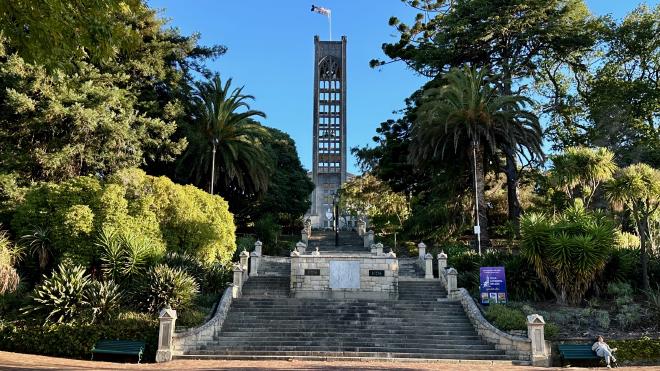
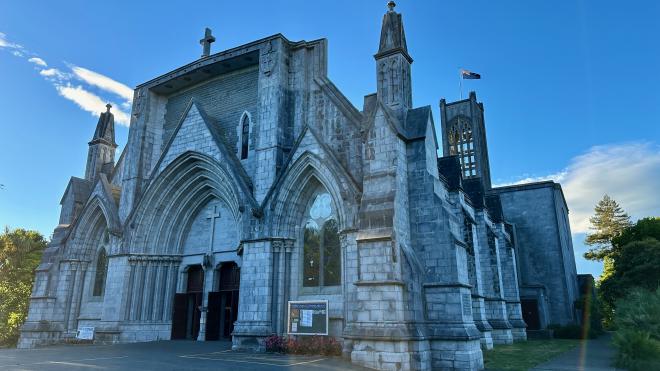
After dinner we headed to Nelson’s main landmark, Christ Church Cathedral. The current structure is the third church on the site, the first having been a small wooden building, the second a small Cathedral with a wooden spire completed in 1887, and the current Cathedral having been built between 1925 and 1965.
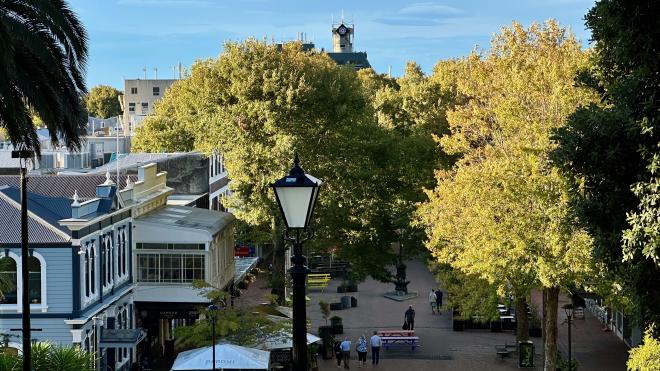
The top of the Cathedral steps offers a view of Nelson’s core, with the city’s other clock tower, at the City Council building, visible in the distance.
The Cathedral is an interesting mix of architectural styles – neo-gothic at the rear, with the modern clock tower at the front.
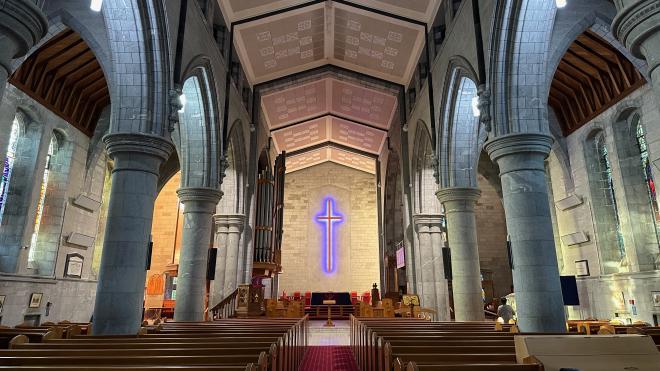
The Cathedral was still open to visitors, so we popped inside briefly.
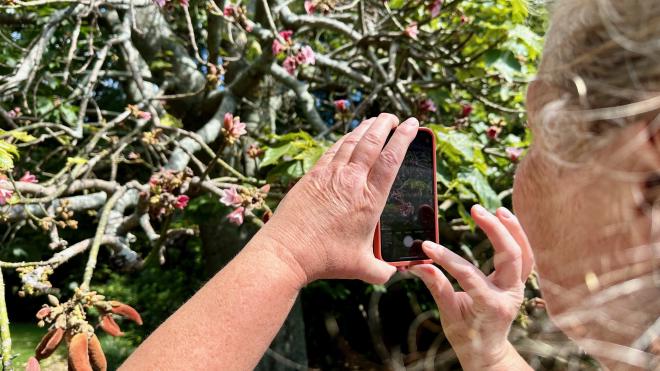
The Cathedral is surrounded by gardens, so of course Karen had to take some pictures of the trees.
The next morning we decided to take a walk to “the centre of New Zealand”, one of Nelson’s claims to fame. Most of our route to the base of the hill was along this very pretty river-side pathway.
Once we were into the Botanical Hill parkland , it was a bit of a climb to reach the “centre”. At the base of the hill is a sports field, on which the first rugby game in New Zealand was played, on 14 May 1870.
The view from the top, of Nelson and its harbour, was well worth the climb.
Here’s Greg, standing on the “centre”. We’re using quotation marks because this isn’t actually the geographical centre of the country, which is about 53 kilometres to the south. However, it is the official reference point for all surveys of New Zealand, and has been since 1877. Prior to GPS technology, a defined reference was essential to ensure that all surveys were correct and mutually consistent. The needle monument was installed in 1968.
We walked back down the hill and along the river towards Nelson’s Queens Garden. Along the way we spotted a few schools of fish.
The Botanic Garden is small but very nicely laid out.
Of course Karen had to get some pictures of the plants…
… and stop to smell the roses.
From the garden we headed to the Nelson Provincial Museum, which has exhibits about the history of the area from the first Māori settlements onwards. Clearly, small town politics is the best!
Part of the exhibit focused on Ernest Rutherford, who was born at Spring Grove near Nelson in 1871, educated at Nelson College, and won the Nobel Prize for Chemistry in 1908. He was later knighted and made Baron Rutherford of Nelson and Cambridge. This is his christening gown. Rutherford’s image appears on the New Zealand one hundred dollar note.
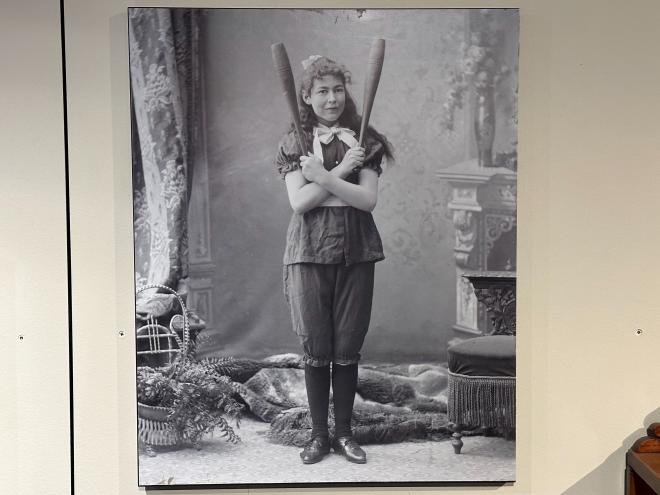
The museum has an exhibit of local photography through the ages. This image of a girl holding Indian clubs, which were used for exercise, was labelled simply “Jones girl c. 1895.” It’s not quite juggling, but we’ll take it.
This is the City Council building, with its unusual brutalist clock tower, which also appears in the photograph from the Cathedral steps.
Karen quite liked the attractive way that concrete paths were joined to asphalt along the river.
Our bus the next morning departed at 7:15 am, which had us up a bit earlier than we normally like to rise. It did give us a lovely view of the river at dawn. And then it was off to Franz Josef.