Our time in Napier was a partly to see that bit of the country, but mostly to meet Greg’s cousin Etty for the first time – which was very exciting!
The back story: In 1959 Greg’s father’s sister, Iris (usually known as “Titch” because she was tiny) emigrated with her family from the UK to New Zealand so Titch’s husband could take up a position in the New Zealand Army. That was the last time Greg’s father Henry saw her. In 1963 Henry emigrated to Canada to get married, and Greg was born a year later. The two branches of the family have been out of touch ever since.
However, armed with some information from his Dad, Greg was able to track down Titch’s daughter Etty on Facebook, and she invited us to stay with her during our visit to New Zealand. So we did!
In case you’re wondering, Etty was the name of Greg’s grandmother, a formidable woman who passed away in 1983. Greg has two cousins named Etty: the one we were visiting, and another, daughter of Greg’s Aunt Doreen (also known as Jane, after Jane Mansfield; that generation was big on nicknames), who lives in Exeter, UK.
The trip from Rotorua to Napier was about four and a half hours, including a stop for lunch in Taupō. We had a picnic in the park with some leftovers from the night before.
The landscape changed quite dramatically on the bus ride, starting out as very green rain forest…
… progressing to browning hills as we approached the coastal plain.
Etty met us at the bus station and drove us to her home, which is north of Napier up the coast, in an area called Bay View. This picture shows how we spent most of the next couple of days: hanging out in Etty’s living room, trading family stories, and catching up on the last sixty-five years. This was wonderful in all kinds of ways, but generating photos wasn’t one of them. And unfortunately we somehow missed getting a photo of Etty’s dog Carly, who was very cute but overly-enthusiastic (to put it mildly).
We did make one excursion into Napier, aided by the loan of Etty’s car (thanks!). After a quick stop at the i-Site (which is what tourist information centres are called in New Zealand), we parked beside the Marine Parade Foreshore Reserve, near the central business district (CBD).
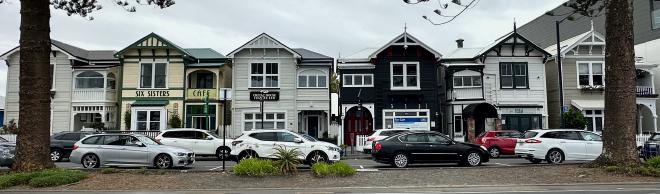
These houses are the Six Sisters. The (possibly apocryphal) story goes that in the 1890s the early 1900s, the manager of the Napier Port had six daughters, so he had a row of six houses facing the water built for them and their families. Three have been converted to businesses but the other three are still private residences.
There is a large Sunken Gardens within the Foreshore Reserve.
Of course, Karen had to take some pictures of the plants.
Napier is known for the Art Deco buildings in its CBD. These were all constructed as part of the rebuilding of the city following the disastrous Hawke’s Bay earthquake of 1931. We’d ventured into town partly to make one of our very rare purchases on this voyage: some sweaters made from a blend of of merino wool, possum hair, and silk. Merino sheep are found primarily on New Zealand’s South Island and their wool is renowned for being very fine and soft. The common brushtail possum is a protected native species in Australia, but in New Zealand it’s an unwelcome invasive pest that preys on New Zealand’s ground-dwelling birds. Possum hair is hollow, which makes it extremely warm.After being in continuous summer since last June, we knew we’d be needing additional layers as we headed further south into the cold of New Zealand’s autumn.
Here’s another of the striking Art Deco buildings.
The Napier City Hall is another striking Art Deco building.
We drove north from the CBD to Centennial Gardens, situated at the bottom of Bluff Hill.
From there we climbed up to the Bluff Hill lookout, by way of Sturms Gully.
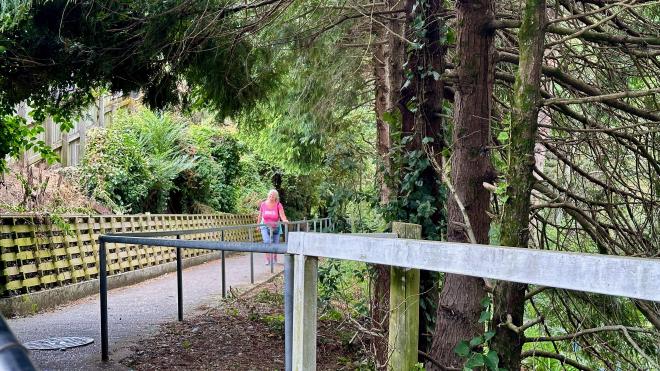
Some of the houses along Sturm’s Gully had lovely back yard gardens.
This is the view west and north up the coast from the lookout. The low-lying land you can see past the bend in the bay rose out of the sea during the 1931 earthquake. This now includes Napier’s airport. Etty’s house is towards the right edge of the picture.
Napier is a cruise port and a lumber export centre. Most of the wood is shipped to China as raw logs.
The next day Greg went for a run from Bay View towards Napier. This is near his turnaround point, about six kilometres south of Etty’s place. The view is more or less the reverse of two pictures up; the grassy hill you can see just left of centre is the grass from that picture.
The next morning Etty dropped us off at the bus station for our trip from Napier to Stratford and we got this selfie. We can’t thank her enough for the hospitality, the lovely meals she prepared, and especially for the chance to make the acquaintance of with a long-disconnected branch of the family. As a result of the visit, Etty is now in touch with several of our cousins in the UK (including her namesake), which seems to make everyone happy.