Our next port of call was Colombo, Sri Lanka, three sea days later. The port was reasonably close to the city centre and most of the attractions we wanted to see, so we decided to visit on our own.
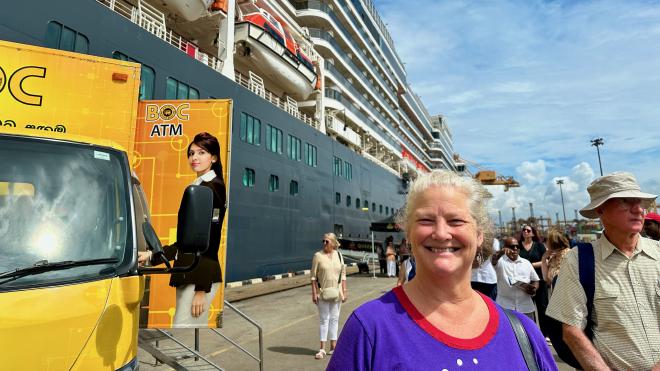
The cruise provided a free shuttle into town. Here we are queued to catch it, beside a mobile foreign exchange bus provided by the local tourism agency. Money is one of the logistical issues with a cruise trip, where you need local currency but will only be in the country about ten hours. There’s no good solution. You can simply pay in US dollars, if the locals will take them, and get burned on the exchange rate; or, you can swap some US dollars or Euros for local currency, and get burned by the exchange rate; or you make a withdrawal from an ATM, and get burned by the withdrawal fees and the exchange rate. Then you likely end up with leftover currency of a country you won’t be returning to any time soon, and have to switch it back, getting burned on exchange again. The best you can do is a credit card with no foreign exchange fee, which we have, but credit cards aren’t always widely accepted, especially in developing nations.
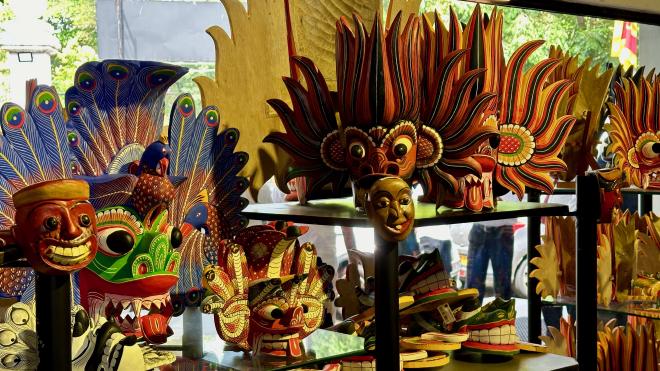
The shuttle dropped us off at the Laksala Store. Laksala is a government-run agency for fostering traditional arts and crafts and providing a sales outlet the for crafts people. There were some amazing-looking carvings and textiles in the shop, so if we had been purchasing any large souvenirs on this trip, it would have been very tempting. As it was, Karen bought a magnet and we headed out.
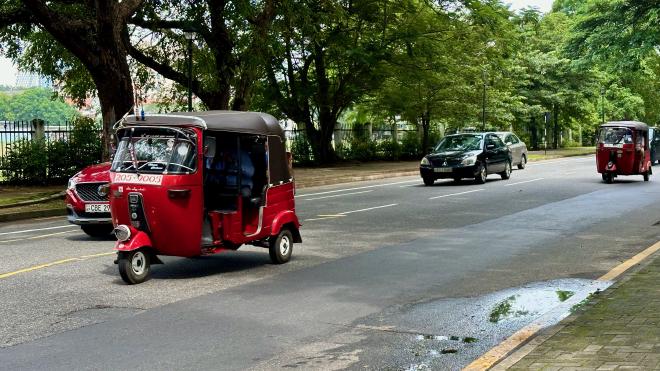
Outside Laksala was a row of about 50 tuktuks, the little three-wheeled taxis, waiting to pounce on departing tourists with “great deals” on personalized tours. We ran the gauntlet; the drivers were shocked and offended when we told them we had our own plans and weren’t interested. But that wasn’t the end of it – for most of the rest of the day we had tuktuks pulling up beside us, sometimes even pulling U-turns to get there, to make us the same offer. After about the twentieth, Greg may have started getting a bit testy with them.
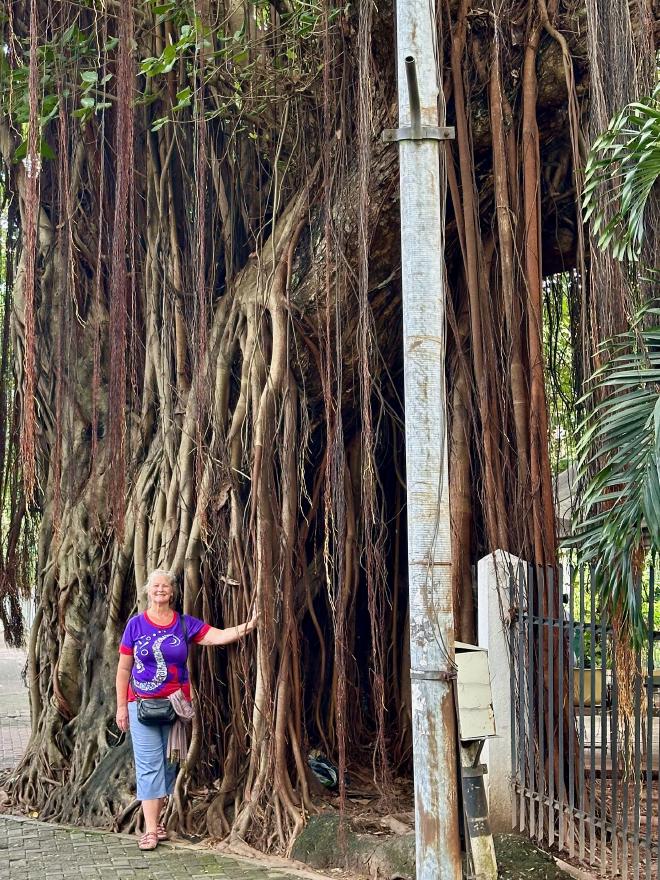
There are large banyan trees on many of the older streets in town. Karen made friends with this one.
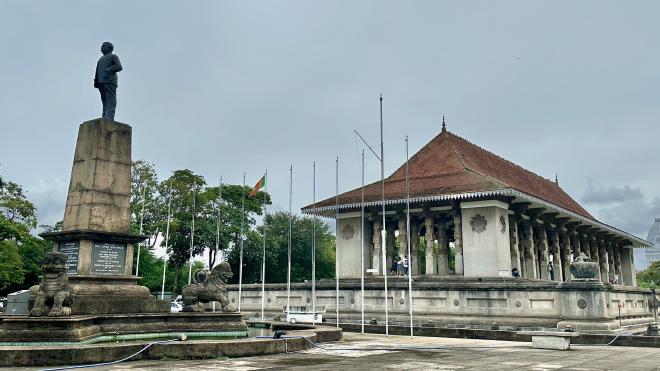
Our first destination was Independence Square, with its Independence Memorial Hall. This commemorates Sri Lanka’s independence from the British in 1948. The statue is of D.S. Senanayake, first Prime Minister of independent Ceylon, as it was then known.
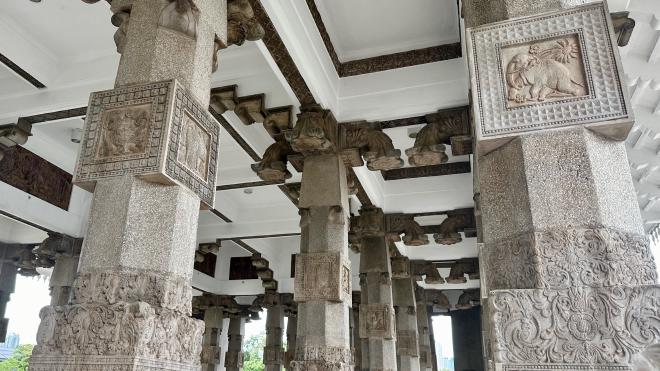
The interior of the memorial features some striking carvings…
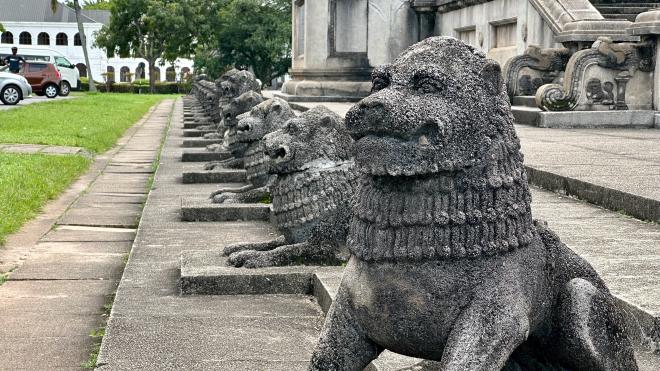
… and the street side is lined with lions.
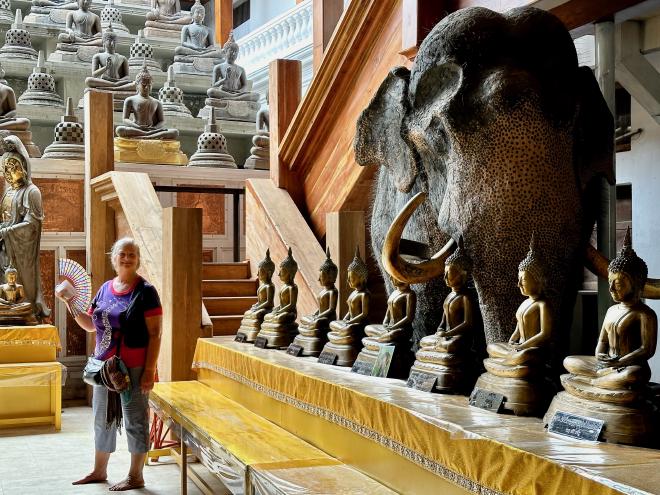
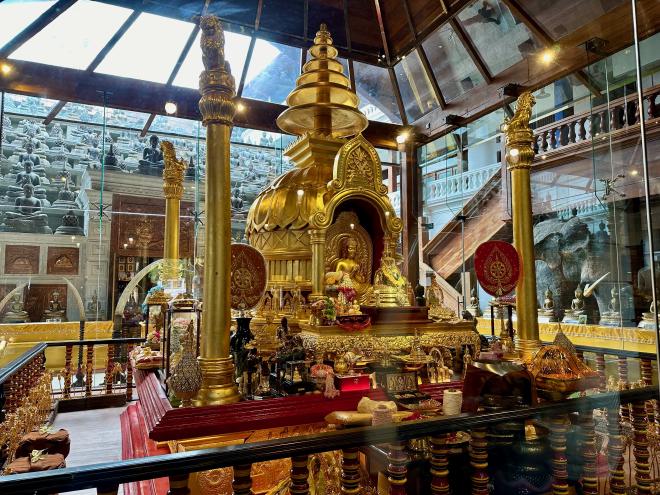
From there we walked to Gangaramaya Buddhist Temple, a sprawling complex with buildings in many different architectural styles. We’re not sure if the elephant was taxidermy or a very lifelike statue, ’though as a rule Buddhists aren’t keen on dead animal bits.
The temple is full of images of the Buddha, in stone, gold, bronze, jade, ivory, and even plastic.
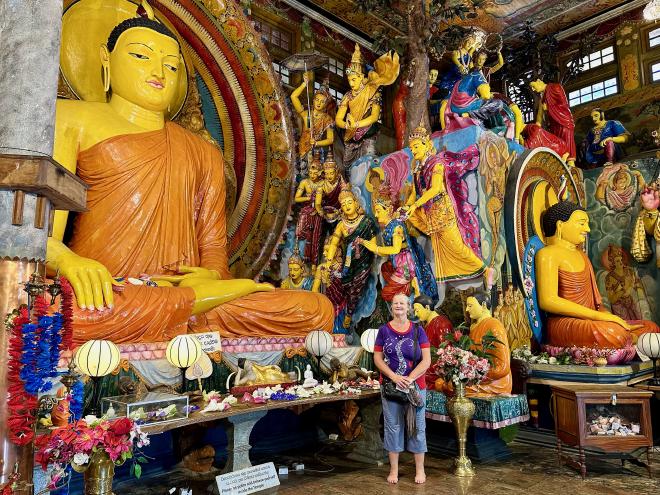
One of the inner temples was filled with brightly-painted Buddhas and other figures in a clearly Hindu-inspired style.
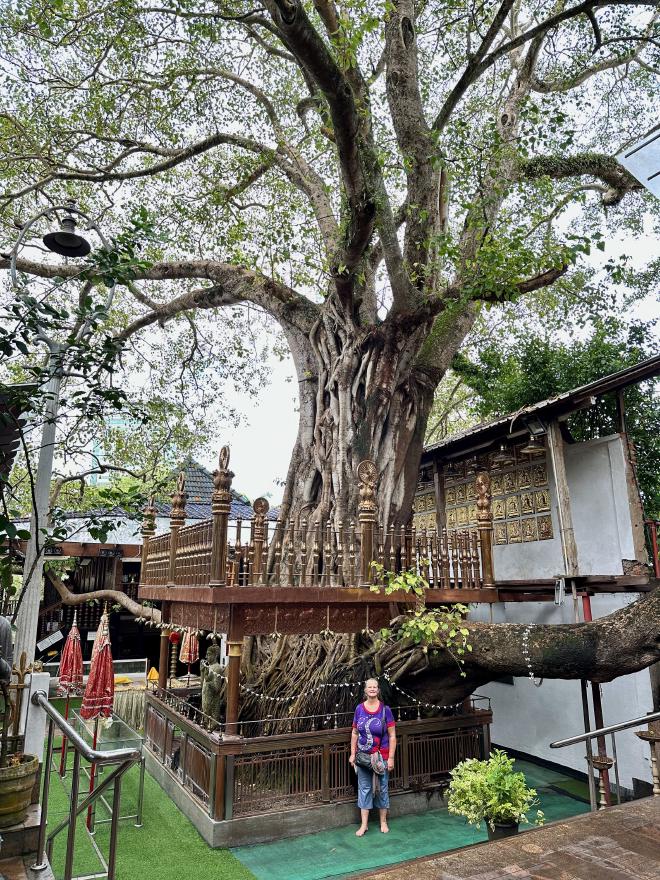
This large tree, in the middle of the temple complex, has a shrine carefully built around it.
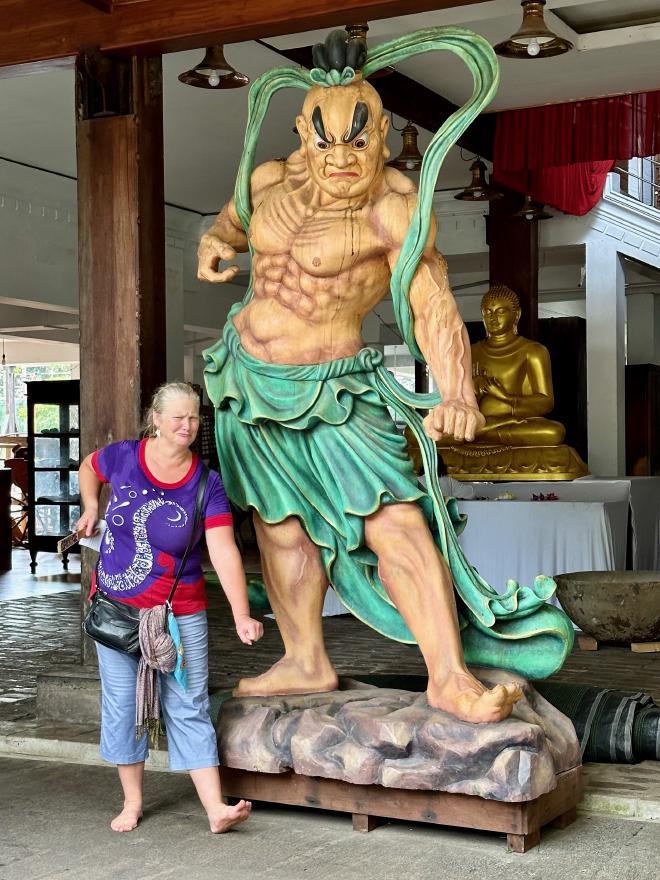
Another of the inner temples was flanked by the traditional Nio guardians. This is Nārāyaṇa (the other is Guhyapāda) with an equally-scary imitator.
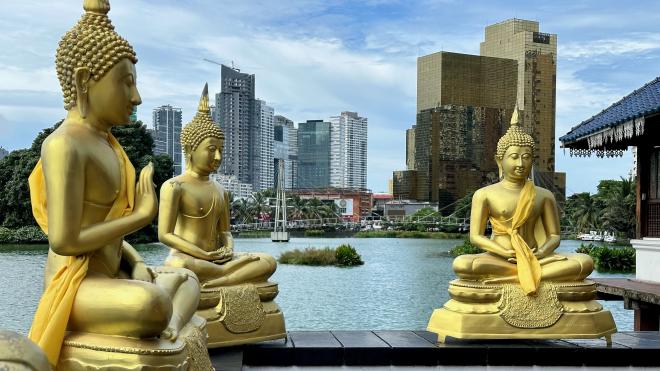
Just around the corner, set on platforms over Beira Lake, is the Seema Malaka Buddhist temple and meditation center.
When we visited, one of the pavilions was having some maintenance done. This human chain, made up of high school students, was moving bricks out to the work site.
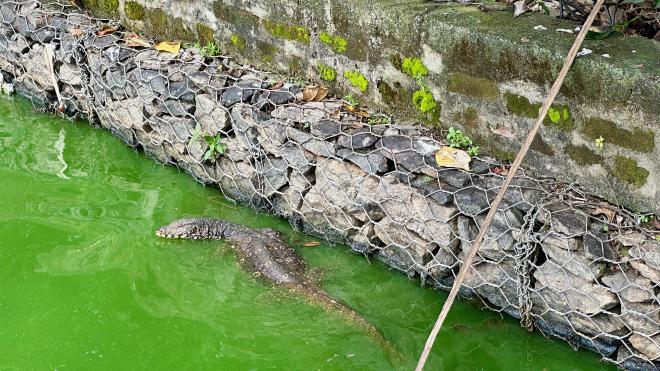
Just beside the temple we spotted this Asian Water Monitor, which was well over a metre long.
From the temples we headed north towards the Old Colombo Dutch Hospital in the Fort district to get some lunch. Here’s a picture of Karen taking a picture of a plant, along our route.
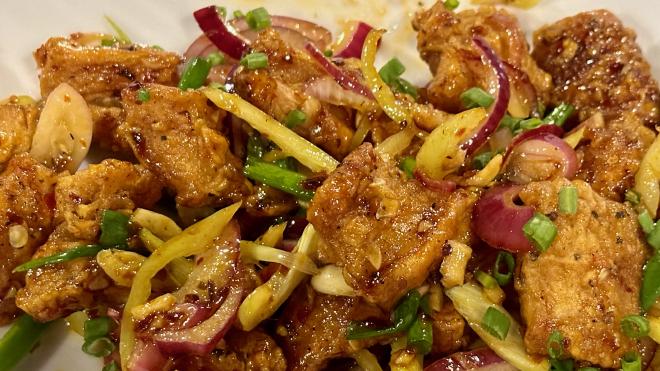
We ate at the Ceylon Curry Club, which seemed to be about 25% tourists and 75% locals during our visit on a Tuesday afternoon. The food was excellent; this was the calamari appetizer, which was sweet, spicy, crunchy and delicious.
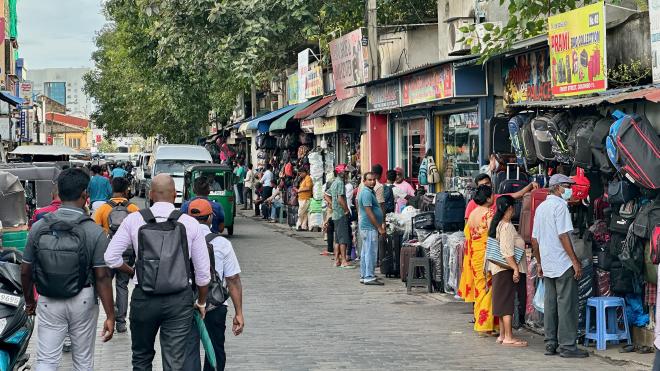
After lunch we walked east into the Pettah Market, a bustling mix of enclosed and open-air shops.
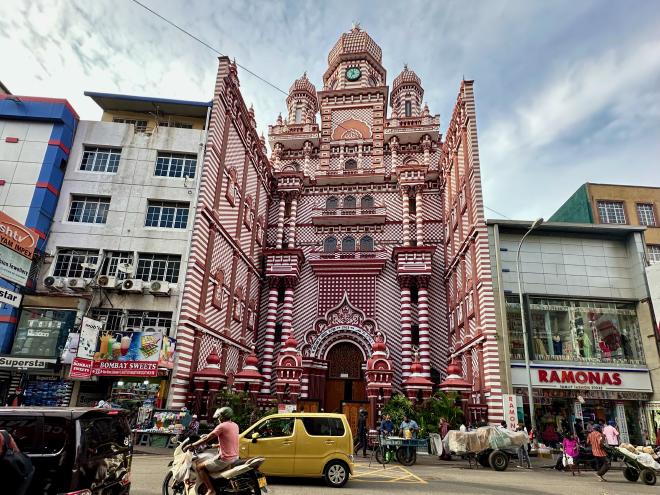
In the middle of Pettah is the Jami Ul-Alfar Mosque, better known as the Red Mosque for obvious reasons. The front, shown here, looks rather odd, with its courtyard sandwiched between a candy shop and a clothing store. The back side is actually quite a bit more impressive, but by the time we got this far we were exhausted and ready to hit the ship, so we didn’t walk around the block.
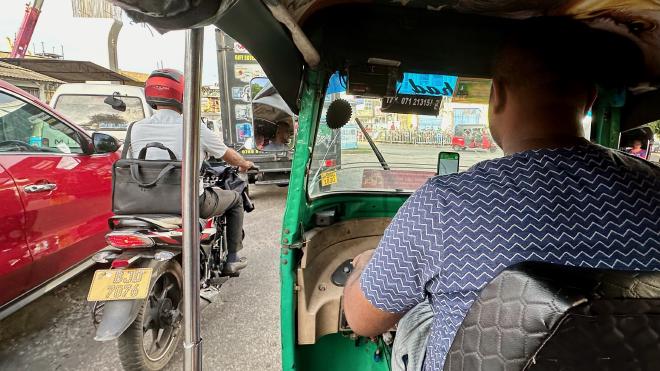
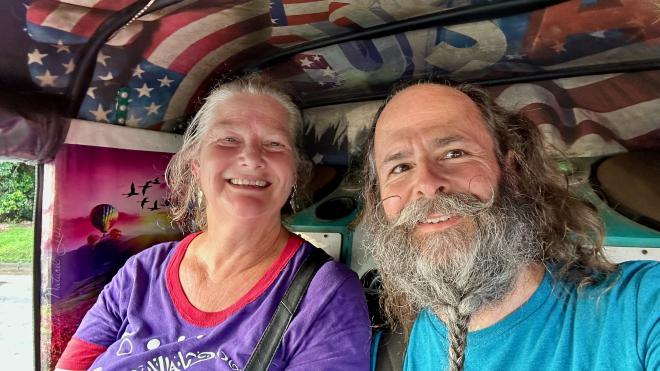
We flagged down a tuktuk driver who actually spoke fairly good English, and explained where we needed to go. He claimed he understood how to get to the ship and took us alongside the port, only to realize that he couldn’t get in. Eventually we convinced him to take us to the port gate, which was several kilometres away and one of the shuttle bus stops. As you can see, Sri Lankans don’t believe the lane markings on the road serve any purpose – there are as many lanes as there need to be, and if you can wedge your vehicle in, it’s fine.
When we got in the tuktuk the driver said the fare would be on the meter. When we got to the gate, the meter read about 2000 Sri Lankan rupees, but the driver insisted on 3000. The difference worked out to a bit over four dollars Canadian (and what were we going to do with an extra thousand rupees anyway?), so we just paid it. Then he insisted that we should give him at least one US dollar, and wouldn’t believe us when we told him we didn’t have any. As Jared said later “the right of locals to overcharge tourists is a time-honoured tradition”.
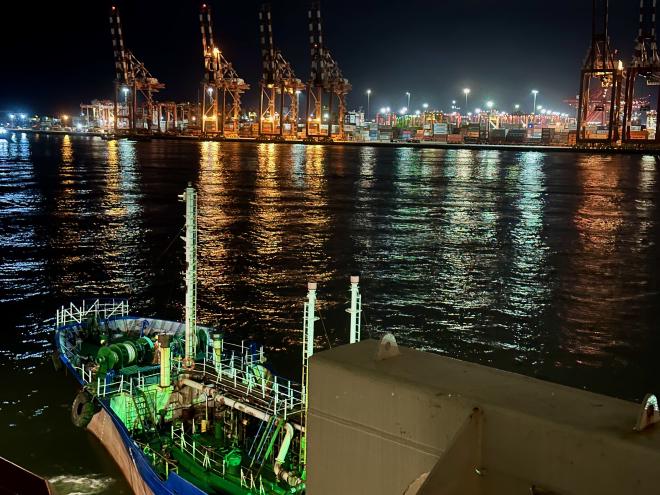
From the port gate we caught the next passing shuttle to the ship. We were supposed to be leaving about 6 p.m., but the bunkering operation (refuelling the ship) took longer than expected so we were still in port about 7:30 pm when Greg took this shot. That’s the refuelling boat just below our balcony, with Colombo’s container port in the background.
The Queen Elizabeth pulled out of harbour as we were eating dinner, and were on our way to Singapore.