Somewhere around Romania we realized that the pace of travel was starting to wear us out and we were going to need a vacation from our vacation. Based on an excellent recommendation from Matty, we had already decided to travel from Türkiye westwards by ferry, rather than taking the long, slow train routes through Bulgaria, Serbia, Bosnia-Herzegovina and Croatia. That meant travelling through the Greek islands, which sounded like an ideal place to stop and do nothing for a bit.
We looked into staying on Lesbos or Mykonos, but after some research we realized we could save a few travel days by simply stopping on Chios, which is the island closest to the Turkish coast. Greg managed to find a very positively-reviewed hotel in the small village of Emporeios Bay, well off the beaten track, which sounded perfect (and was!). And from Chios we could take an overnight ferry direct to Piraeus, the port of Athens.
This was our first time travelling on a ferry since our trips to and from Visby with Maria. The Swedes have everything well-organized and make foot passengers feel welcome. Unfortunately that was not our experience here or on subsequent ferry voyages in southern Europe, where most terminals seem to treat foot passengers with indifference verging on contempt. This is the waiting area for the ferry in Çeşme. Elegant, right? However, once our ferry arrived and we boarded, it was just a quick 25 minute hop to Chios.
On arrival in Chios we had to clear through immigration and customs, since we were re-entering the Schengen area. Karen’s bag got flagged for a hand-search; apparently her collection of bars of soap look like smuggled cigarettes on an x-ray machine. We had been told by our the hosts at our hotel that we could expect taxis immediately outside the ferry terminal, but there were none. Greg politely asked the customs officials in the terminal to call us a cab, and we were shortly on our way from Chios Town to Emporeios Bay, where we were to stay for the week. This is a traditional Greek windmill on a hilltop, as seen out the window of our taxi on the forty-minute ride.
The whole point of our stop in Chios was to do a bunch of nothing and recover from our travelling, so we’re not going to describe what we did each day. In fact, most days looked pretty-much the same: breakfast at the hotel, a bit of work, most of the day by the pool or possibly at the beach, followed by dinner at one of the nearby restaurants, then maybe watch a movie on Greg’s laptop in the evening, and an early night to bed.
So, rather than a day-by-day recount, we’ll say a few words about the village of Emporeios Bay, the hotel, the restaurants, the beach, our one excursion to a nearby archaeological site, local mastic production, and the day we spent in Chios Town before catching our ferry to Athens.
This is the village of Emporeios Bay, as seen from the archaeological site on the hill beside it. It’s partly a working fishing and agricultural town (about which more later) and partly a summer resort with many vacation homes. We stayed at the village’s one hotel, the Emporeios Bay Hotel, which is marked by the arrow. The village has five restaurants, all clustered on the waterfront near the wharf. And there’s a beach in the next bay up, about a five minute walk from the hotel. The only other service in the village is a tiny convenience store where we bought water and snacks; for anything else you’d need to travel to the nearest town, about five kilometres away.
Speaking of snacks, here’s another new-to-us chip flavour: oregano.
This is the harbour, as viewed from the main wharf. You can see three of the five restaurants in this shot. The other two are just around the corner, one either side of the street.
The harbour from the other end, looking back towards the wharf. The archaeological site is on the left-hand side of the hill, about half-way up.
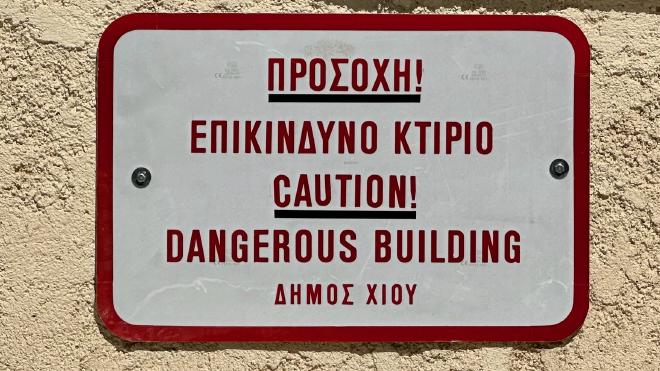
This sign was on a building beside one of the restaurants. We kept waiting for it to leap out and threaten us, but it never happened. Alas.
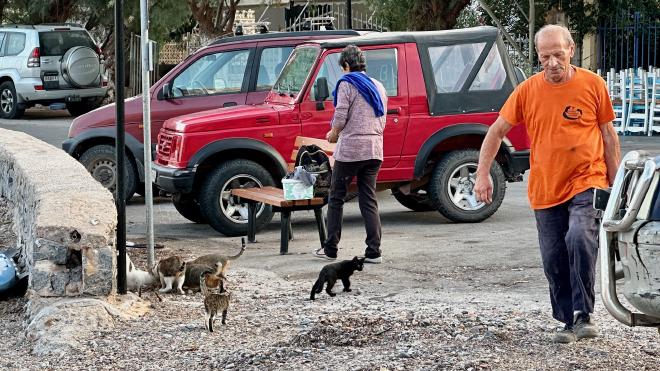
In the evening, the fisher-folk come down to the harbour and head out in their small boats. A few of them stop to feed the many street cats that live in the village.
On our last full day in Emporeios the Greek Navy was conducting an exercise off the coast. We spotted three frigates and a resupply ship. Fifteen naval pilots stayed overnight at the hotel; they were flying out of a nearby air base.
The Emporeios Bay Hotel is a small, family-operated establishment that’s open from late April through mid-October each year. The husband and wife team who run it, Ilias and Giouli Kampas, are extremely welcoming and helpful. They put on a terrific breakfast buffet of sweet and savoury dishes, at least a few of which change each day. This is the table we ate at, most mornings. The building you can across the pool contains long-stay apartments and is also part of the hotel complex.
We made good use of the pool. The breakfast patio and some second-story rooms are just behind Karen. We were on the other side of the hotel, facing the (very quiet) street.
Karen, on the balcony of our room.
We did a bit of juggling and poi swinging by the pool, much to the amusement of the hotel staff. We had just one day of threatening skies, which you can see here. Fortunately the rain stayed north of us.
The hotel has beautiful gardens which Karen enjoyed. Here’s another in our series of pictures of Karen taking pictures of plants.
This was dinner on the evening of our arrival, which was pretty similar to dinner every other night, in the best possible way. We tried all five of the restaurants in turn and found them all delicious. They each offer a range of fish and meat dishes, including locally-caught fish, plus salads, spreads, and desserts. Menus are slightly different and their take on common dishes is varied, but you’d need more than a week to try them properly and pick a favourite. Fortunately, they all sell Fresh Chios Beer from Chios Microbrewery, which was delightful. All of them bring you a small sweet with your bill, which was nice as we seldom had room for a full dessert.
Since the restaurants are all on the harbour, they offer excellent views.
One evening the moon was rising over the harbour just as the sun set.
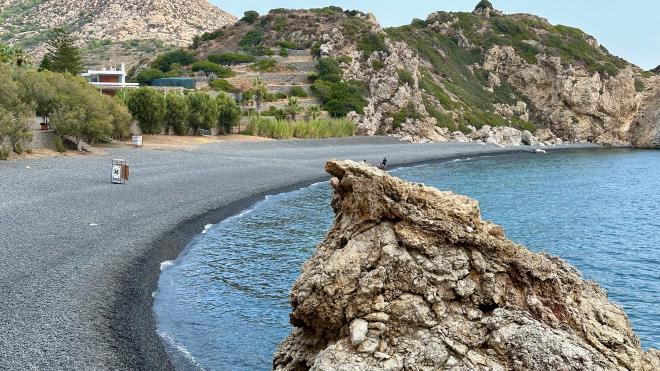
It’s in a lovely, crescent-shaped bay, surrounded by olive trees. There’s a small hotdog and sandwich restaurant at one end of the bay (not shown). The beach was mostly empty during our stay, probably because we were right at the end of the season.
The beach is made up of black “pebbles”, ranging in size from what you see here…
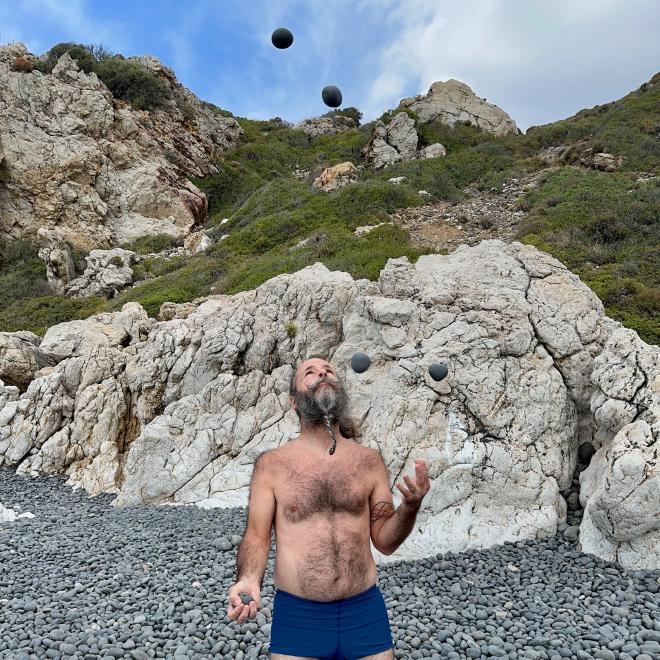
… to large enough to juggle.
And here’s another picture of Karen taking pictures of plants.
Our one excursion was to the Archaeological Site of Emporio, on the hill above Emporeios Bay. Getting to the entrance of the site was a two kilometre walk with about ninety metres of climb. From there to the highest point in the site, the Temple of Athena, was about another seven hundred metres with fifty metres of climb. We were very glad we’d brought water with us!
The bronze-age site, dating from the 8th and 7th centuries BCE, was excavated by British School at Athens between 1952 and 1955. It consists of a number of houses and other minor buildings, leading to an Acropolis temple complex higher on the hill. You can see a map of the site at the top of this sign, with a typical building description below it.
Many of the buildings had spectacular views of the bay. However, there are no water sources on the hill, so it would all have had to be carried up by human and animal labour.
In Emporio, all roads lead to the Acropolis.
This is the Temple of Athena at the Emporio Acropolis, which is the largest structure on the site. You can see the altar towards the back.
Many of the rocks on the hill had interesting weathering. This was our favourite.
The obligatory selfie overlooking the village of Emporeios Bay.
Chios is the traditional centre of mastic production, so much so that mastic is known as Tears of Chios. These are mastic trees. The white substance you can see around the tree bases is calcium carbonate, spread to keep the mastic drops clean when they fall to the ground.
Mastic is a dried tree gum. During the harvest period, which runs from July through October, the trees are sliced every five to ten days so that the sap runs out and dries before falling to the ground. Mastic is believed to have been the original chewing gum. It is used as a flavouring and thickener in a variety of dishes. There is also a liqueur, mastika, made from the resin. The flavour is somewhere between mint and cedar or pine.
Our ferry to Piraeus was leaving late in the evening from Chios Town, and we had to head there in the morning, so we needed a place to store our bags. A web search had turned up zero options for luggage storage, so we were considering renting a cheap hotel room just for the bags. We mentioned this to Giouli one morning and she had a better idea: in addition to the Hotel, the Kampases run a car rental business that’s headquartered right on the Chios Town harbour. Ilias made a quick phone call and we were good to leave our bags in the rental office until closing time at 8 pm, which was just about perfect. See, I told you they were helpful!
So, we hopped in another cab, drove to Chios Town, dropped our bags at Kapmas Rent A Car, and spent the day exploring.
Much of Chios Town is quite modern, but the old walled city (the Castle of Chios) is still there, full of homes and restaurants.
Karen liked these flowers.
The main archaeological site inside the Castle walls is this Turkish Bath, dating from the Ottoman era. Unfortunately we were there on a Tuesday, which is the day archaeological sites and museums throughout Greece are closed, so we couldn’t visit the inside.
The Castle’s Seaside Wall is about 250 metres long, with elements dating from Byzantine construction as far back as the 13 century, and significant further construction in the 14th and 15th centuries by the Genoans and Venetians.
The Castle’s landward walls are a site of active archaeological research and restoration.
The Seaside Wall has a commanding view up the coast.
We walked from the Castle to these four restored windmills. The originals date from 1881 and provided power to neighbouring tanneries.
We also took a walk all the way around Chios harbour, which was full of fishing boats, sailboats large and small, and even a few super yachts.
For dinner we went to the βραδύπους (Vradipus, or Sloth) restaurant in the Castle, which had been recommended by Giouli as offering a modern twist on island classics. We were very happy with the food, and also with the drink.
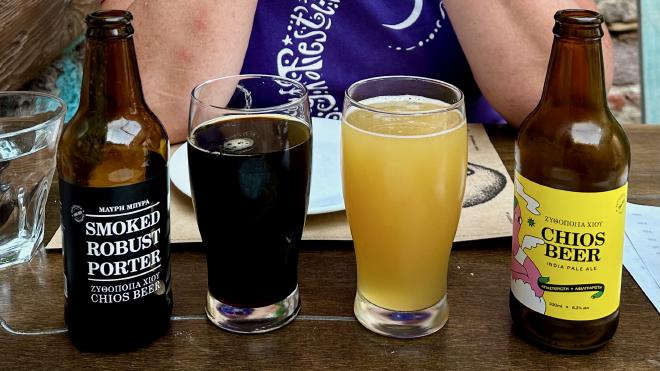
Where the restaurants in Emporeios Bay had just Fresh Chios Beer, βραδύπους offered a wide selection from Chios Microbrewery, including their smoked porter and IPA, both of which were excellent.
The restaurant also featured cute kitties snoozing on a chair.
From the restaurant we picked up our bags and headed to the harbour to wait for our ferry. As in Çeşme, the waiting area was particularly elegant. (The real waiting area was just around the corner to the right, and actually had some benches, but it had no view of the harbour and wasn’t any more comfortable than this. We waited here until our ferry was about to arrive, when one of the harbour officials insisted we move to the official waiting area “for our safety.”)
Eventually our ferry, the Nissos Samos, arrived. It was enormous; so large it almost filled the harbour and had to turn in place using its bow and stern thrusters so it could back in to the dock.
Then it was onto the ferry, into our cabin, and on our way to Athens.