As we mentioned in part 1, Tuesday’s plan was built around visiting the two major mosques that we missed on Monday: the Hagia Sophia Grand Mosque and the Sultan Ahmet Mosque (aka the Blue Mosque). Both mosques are current places of Muslim worship, which means prayers five times a day. They are open to visitors only between prayers, so planning is a must. Fortunately, the Turkish government publishes a list of the prayer times each day. Neither mosque charges an admission fee.
The queue to get in to Hagia Sophia was over a hundred metres long, but moved very quickly once the mosque opened to visitors. This is the entrance area, where we left our shoes in the provided cubbies before entering the mosque proper.
Built as an Orthodox Cathedral between 532 and 537 CE at the order of Emperor Justinian I, the Hagia Sophia has a complex history. It was the third cathedral on the site, its two predecessors having been destroyed by riots in 404 and 523 CE. The cathedral remained Eastern Orthodox until 1204 when it became Catholic following the Fourth Crusade, only to be reclaimed as Orthodox in 1261. When the Ottomans conquered Constantinople in 1453, the building was converted to a mosque, including the addition of minarets. It remained a mosque until 1935, when it was converted to a museum as part of President Atatürk’s secularization of the newly-formed Republic of Turkey. It was reopened as a mosque, after a contentious legal and political process, on 24 July 2020.
Modest dress is required of all visitors to mosques, including long trousers or skirts, covered shoulders, and covered heads for women. Long gowns with hoods are available free for anyone who arrives inappropriately dressed. Despite the crowds, the mosque was very quiet. Many of the visitors, including us, found a relatively calm spot to sit and absorb the atmosphere.
The Hagia Sophia is enormous and roughly square, essentially impossible to show in a single photograph. This wide angle shot was the best we could do to capture a sense of the space. As you can see, some areas of the frescoes are badly in need of restoration; however, given the building’s history, exactly what should be restored is a complex question.
There are still a few visible remnants of the mosque’s time as a Christian church. This tenth-century mosaic, beside the main entrance, shows Emperor Justinian holding a model of the Hagia Sophia and Emperor Constantine holding a model of the city, which they are presenting to the Virgin Mary holding the child Jesus.
From the Hagia Sophia we went directly to the Sultan Ahmet (Blue) Mosque. Along the way we bumped into a very genial gentleman who complimented Greg’s moustache and tried to convince us that the mosque was closed to visitors for prayer, so we should accompany him to his sister’s carpet shop for tea while we waited for the next opening. However, armed with the actual timetable, we politely brushed him off. This is the Blue Mosque’s courtyard. The mosque was built in 1609–1617 at the direction of Sultan Ahmed I. At the time of its construction it was only the second mosque in the world to have six minarets, after the Masjid al-Haram in Mecca. During the Blue Mosque’s construction, the Masjid al-Haram added a seventh minaret to reestablish its preeminence.
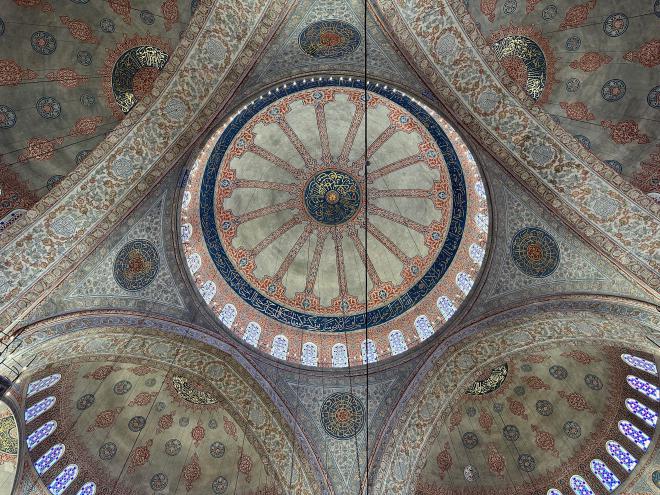
There was no queue to enter the Blue Mosque, so we were quickly inside. The mosque’s interior walls are almost completely covered with tiles, in intricate Islamic patterns. This is the central dome.
The mosque features 260 windows, mostly in blue stained glass. These, along with the blue colours on the tiles, give the mosque its nickname.
On leaving the Blue Mosque we proceeded to the Hippodrome, once site of a giant stadium for chariot races, now a long plaza. We bumped into the same genial gentleman as before, who unashamedly asked whether we’d enjoyed the mosque, and invited us once again to visit his sister’s carpet shop. We declined. Behind Karen you can see the Serpent Column and the Obelisk of Theodosius.
The bronze Serpent Column was constructed in the 5th century BCE by the Greeks, commemorating their victories over the Persians in 480 and 479 BCE. It is believed to have been made from the melted-down shields of the defeated Persians. During the establishment of Constantinople it was moved to the Hippodrome on Emperor Constantine’s orders, where it has remained to this day. Originally each of the three pillars ended in a serpent’s head, but these were destroyed and lost in the 16th century. One jaw was later discovered and is in the Istanbul Archeological Museum. The column was eight metres high, of which only about five metres remain. Its base was originally at ground level, but time and subsequent construction raised the surface around it; excavations to reveal the full column were completed in 1857.
Like the Serpent Column, the Obelisk of Theodosius is Roman plunder. It was originally constructed under Pharaoh Tutmoses III of the 18th Dynasty of Egypt around 1450 BCE in front of the Temple of Amun-Ra at Karnak, only to be removed to Constantinople on orders of Emperor Constantine. Also like the Column it was partially buried for many centuries and its base only excavated in 1857. The obelisk is believed to be missing its bottom third, and currently stands 19.6 metres high. This photo shows its plinth, which dates from the time of Roman Emperor Theodosius I, who had the obelisk erected in the Hippodrome.
After a visit to the mosques we were feeling a bit peckish, so we paused for some water and snacks. Karen is holding a simit, which is a ubiquitous Turkish street food vaguely similar in texture to a Montreal bagel. We started with one filled with cheese, and followed that with a Nutella-filled simit for desert. The cost was 15 Turkish Lira each, which at the time was equivalent to $1.05 Canadian. But Türkiye has both extreme inflation and a constantly-falling currency, so those prices are already out of date by the time we’re writing this.
The other ubiquitous street food is roast corn and roast chestnuts, also quite reasonably priced.
From the mosques we proceeded to the nearby Basilica Cistern. Built on orders of the Eastern Emperor Justinian in the 6th century, the Cistern is just one small part of an extensive urban water system dating back to at least the Emperor Hadrian in 117 CE. Surrounded by salt water on three sides, and having no integral rivers, urban Istanbul has always been reliant on aqueducts and pipelines from the nearby (and distant) forests and hills. The constructed waterways already totalled six hundred kilometres by 380 CE.
The cistern is about 100 metres long and 55 metres wide, with 336 pillars. Now mostly empty, its water level would have been much higher when in active use.
Most of the pillars are quite plain, but a few are highly decorated or have elaborately-carved bases. This is one of a group of plinths with sideways and upside-down heads.
This pillar is known as the Pillar of Tears, for obvious reasons. Allegedly, if you put your ear to the stone, you can hear the pillar weeping. Unfortunately it was a bit too far from the walkway for us to test that.
Many of the pillars have elaborately-carved capitals.
After visiting the Cistern we still had some time before our planned dinner with Funda, so we decided to walk to the nearby Kapalıçarşı (Grand Bazaar). This is one of the upscale shopping streets on our route there, just off the Hippodrome.
And this is a very small part of the Grand Bazaar itself. With 61 covered streets and over 4000 shops, the Bazaar is one of the largest in the world. Its core was constructed starting in 1460, shortly after the Ottoman conquest of Constantinople, and it has been extended, burned down, rebuilt, knocked over by earthquakes, etc, on many occasions since.
Just north of the Grand Bazaar is this twisty maze of medieval streets, featuring a wide selection of decidedly non-touristy shops.
Funda had insisted that we try “real” kebap (kebab) while in Istanbul, so we took her for dinner at the place she recommended as most authentic: the İskender İskenderoğlu restaurant near the Kadıköy ferry terminal. On hearing the word “kebab”, most North Americans probably think of shish kebap, which is marinated cubes of meat and vegetables grilled on skewers. It turns out there are at least 18 distinctly different kinds of kepap just in Türkiye, and many more worldwide. For Funda, “real” kepap is İskender Kebap, which was invented in the city of Bursa by the founder of İskender İskenderoğlu and is the only dish this restaurant serves. You have one choice to make: large, medium, or small. We had medium; Funda, being wiser, had small. The dish consists of beef grilled on a vertical skewer, thinly sliced and coated with a tomato sauce, served over crisp chunks of toasted pita, with melted butter poured over at the table. It’s accompanied by grilled peppers, grilled tomatoes, and yogurt. As Funda had promised, it was delicious. The original İskender İskenderoğlu restaurant was opened 1867 – so it’s as old as Canada. It’s been run by the same family for six generations and is now a chain with eleven restaurants around Türkiye.
On Wednesday we’d booked a Bosporus dinner cruise that left from the European bank some ways north of the Golden Horn. We decided to plan our day around that and took an afternoon ferry from Kadıköy to Karaköy, so that we could visit the Galata Tower and then make our way slowly north towards the cruise dock.
This is the Galata Tower, built between 1348 and 1400 CE when this part of the city (Galata) was controlled by the Genoan and Venetian Empires. Galata was essentially a city within a city, surrounded by walls and protected by this tall observation tower. The area remained Genoan until the Ottoman conquest of Istanbul in 1453. The tower has had a varied history in the centuries since, including time as a prison, fire watch tower, coffee shop, and now museum. It is the launch site of the first claimed intercontinental flight, by Hezârfen Ahmed Çelebi in 1638, ’though the accuracy of that story is disputed.
As befits a watch tower, Galata has commanding views in all directions. This is the view south-east, including the Golden Horn in the foreground, the Topkapi Palace at left and Hagia Sophia at right.
This is much the same view, improved by adding Karen.
And here’s a slightly south-west-facing selfie.
This panoramic shot eastwards shows mostly the Bosporous, with Asia on the far side and just the edge of the Golden Horn at right.
There is an elevator up to the sixth floor of the tower, with those seeking a view being required to walk up two further floors. Visitors are encouraged to walk down and visit the lower five floors, which contain a museum presenting displays from and artifacts about the tower and the history of the surrounding area. This is a section of chain dating from the Byzantine period. In times of danger, the chain would be suspended across the mouth of the Golden Horn to prevent enemy ships from entering. When the Ottomans invaded in 1453, the chain forced Sultan Mehmet the Conqueror to drive his warships over land into the Golden Horn – but he took the city regardless.
We wandered slowly north along whatever route looked most promising. This is one of the major shopping streets in Beyoğlu, north of Kadiköy.
Istanbul has a long history as a Christian city, and there are many churches. This is the Church of Saint Anthony of Padua , the largest Catholic church in Istanbul, which we passed along the way.
The sun set and the moon rose at nearly the same time, allowing Greg to capture this shot of moon over mosque.
Türkiye runs almost entirely on cash, and many places do not accept credit cards. This is partly a feature of Türkiye’s extreme, ongoing inflation: at some times the value of loans declines faster than the interest that can be charged on them. Also, Turkish banks do not cooperate with one another for no-fee ATM transactions. As a result, there are rows of ATMs from all the major banks in shopping districts, at ferry terminals and train stations, and anywhere else commerce might take place.
Eventually we reached our dinner cruise dock and boarded the Mega Lüfer, which is a converted luxury yacht. The passengers seemed about evenly split between tourists and locals on a fancy night out. The meal was surprisingly good and the service was excellent, which hasn’t always been the case on “dinner and” excursions we’ve taken before. After dinner we were given some time to spend on deck before the show was to begin. This is a view looking north up the Bosporus.
And this is the view looking east, once again improved with the addition of Karen.
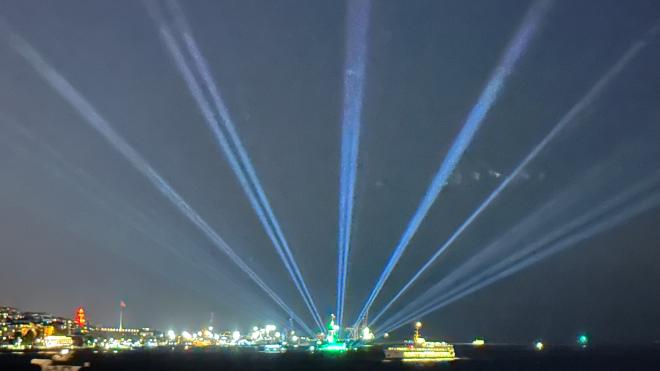
This light show was coming from the base of the Maiden’s Tower, which we had walked past a few days previous.
The 15 Temmuz Sehitler Bridge (15 July Martyr’s Bridge, also known as the Bosporus Bridge or the First Bridge) with the Çamlıca Mosque on the eastern bank.
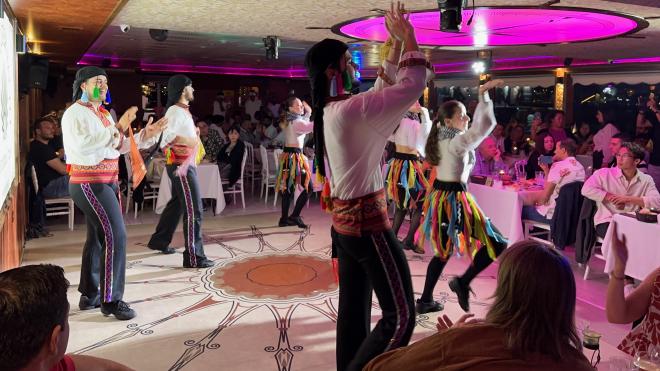
The floor show included a company of six dancers plus a bellydancer. This is a very non-traditional rendition of the Whirling Dervish, which is actually a Sufi meditative practice and not at all appropriate for a cabaret show. But hey, give the crowd what they want!
The main dance company performed several numbers, in a variety of styles, with lightning costume changes in between. They were quite good and seemed to be enjoying themselves. This was a Greek dance, which was a mild surprise given the historical enmity between the Turks and the Greeks.
Karen reports that the bellydancer was quite skilled. Greg reports that she was a lot of fun to watch. She did an audience interaction section and happened to pull Karen up to dance with her. Her surprise when the middle-aged white chick knew the moves was evident, as was her delight when Karen gave her a zagareet at the end of her show.
After the professionals had finished, the audience was invited to join them so of course Karen went up for a few dances. The floor was actually pretty full, but Greg managed to snap a lucky moment when there was a brief space around Karen.
Getting home from the cruise was a bit of an ordeal. According to both Google and the official schedules, we should have been able to catch the last ferry from Karaköy to Kadıköy, but when we got to the terminal it was very definitely closed. So, our options were taxi or the night bus. Being adventurous (and, at least in Greg’s case, contrary) travellers, we decided on the bus. This required us to take the tram back to the cruise dock then walk north about a kilometre to the nearest night bus stop. Along the way we passed the Dolmabahçe Palace, which was quite beautiful in the lights.
We arrived just after one bus had left and had to wait almost half an hour for another. In some circumstances we would have been nervous standing on a foreign street in the middle of the night, but the bus stop was right across from a university gate that had constant foot traffic and there were two young women, likely students, waiting with us at the stop. Once we had made it across to the Asian side we had to change buses at what is probably the most confusing multi-level bus transfer point we’ve ever seen, but we eventually figured it out and made it back to Funda’s without incident. Pro tip: if you’re riding a night bus in Istanbul, sit down and brace yourself: the drivers are maniacs.
After our late night on Wednesday we decided to spend Thursday relaxing and preparing for our departure. Funda had arranged a farewell evening picnic with some of her friends in Kalamiş Atatürk Parkı, so that was the only real event on the schedule.
Funda drove us first to pick up one of her friends, and then to the park. Unfortunately, we hadn’t realized there was a football (soccer) match on that evening, and we ended up driving past the stadium just as the crowds were arriving. On our way back, this section of the drive took about two minutes. On the way there, thirty.
The park is fairly near the stadium, so finding a spot for the car was a challenge. Funda eventually resorted to dragging a trash bin across the street to make a space, and parking illegally at a corner. She figured with all the cars there for the game, the chances of getting a ticket were pretty small – and she was right.
Sunset from the park was lovely.
Dinner was mostly dishes that Funda and her friends had prepared, with one exception that Funda had stopped to pick up on our way. This is the brown dish on the tray at right. Called cig kofte (literally “raw meatballs”), and with a distinctly meaty texture and taste, it’s actually vegan and made from bulgur, pomegranate juice, and spices. Everything was delicious!
We ate dinner by headlamp and phone flashlight under the trees beside a skate park. Many cats wandered by looking for a handout; Funda came prepared and set out a bowl of kibble a distance from our picnic blanket. After dinner, Funda and Greg did some club passing under a light by the pathway.
The next morning, after a nice breakfast, Funda drove us to the nearby station and it was onto the train for Ankara.