From Cluj-Napoca it was onto another wonderful Romanian train towards Bucresti (Bucharest), which was different from, but just as uncomfortable and badly maintained as, the train that got us to Cluj. We’ll spare you the pictures.
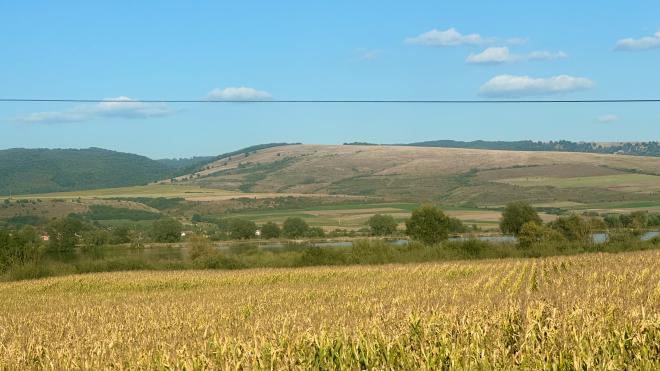
The countryside between Cluj-Napoca and Bucharest is mostly rolling hills and farmland, with corn and sunflowers being the main crops we could see. This photo is near the town of Mǎieruș.
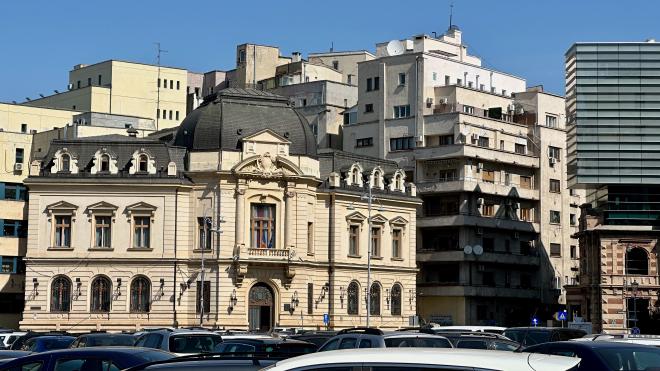
We took a bus from the Bucharest central station to the neighbourhood we were staying in, just north of University Square and the old city centre. It was an eclectic mix of older, elegant buildings and modern blocky structures. If you look at the right of this picture you’ll see a bit of both: the glass cube is stacked on the brick building beneath.
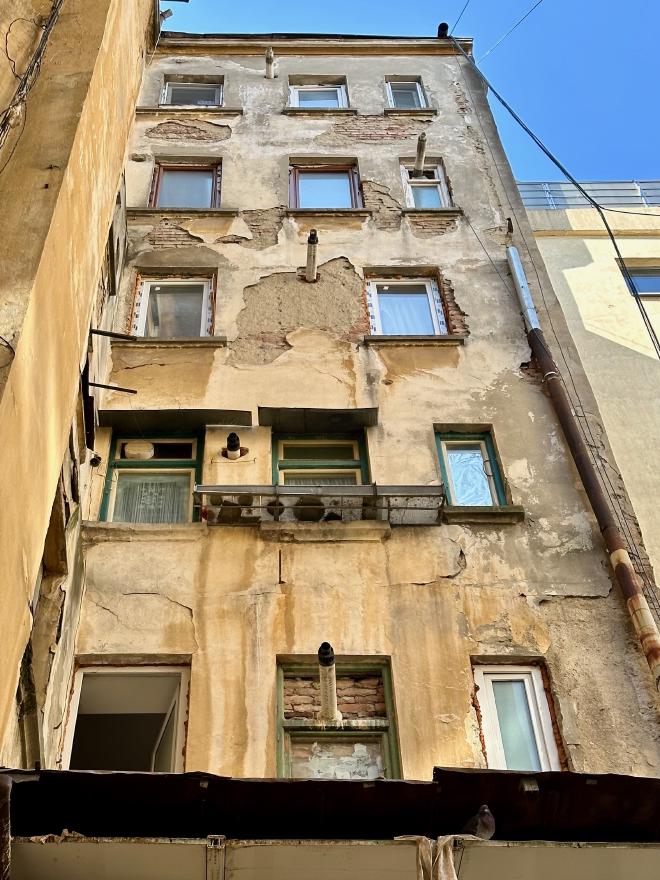
The exterior of our apartment building, viewed from the inner courtyard. Our apartment, on the second floor from the top, was completely renovated, modern, and very comfortable. According to our host, most of the building’s residents are older folks without much money, so repairs to common areas like the building façade are difficult to arrange.
The next morning we decided to start by visiting what is arguably Bucharest’s largest (ahem!) tourist attraction: the Palace of the Parliament.
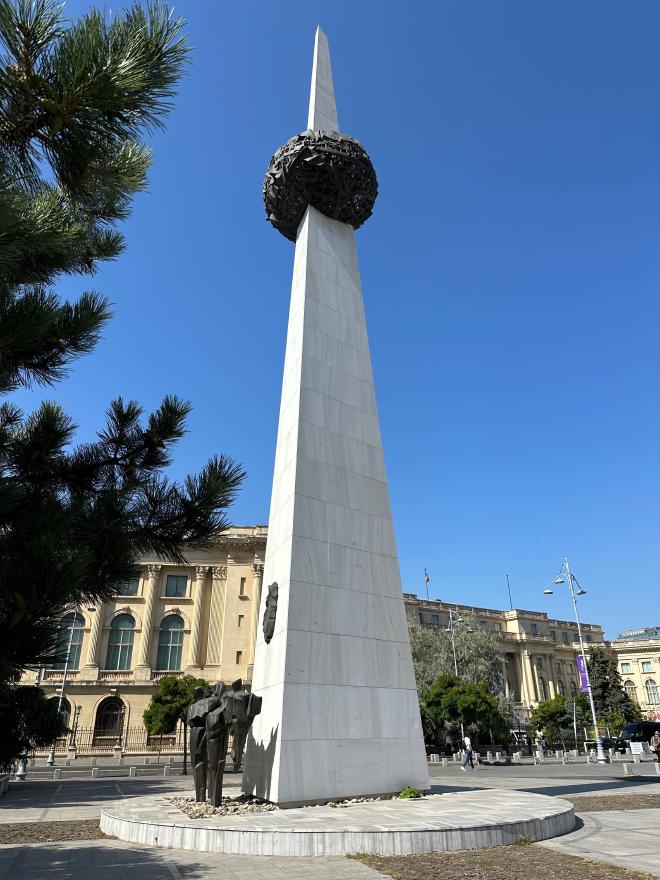
We walked to the Palace via Revolution Square with its famous Memorial of Rebirth, also known as “the potato on a stick”.
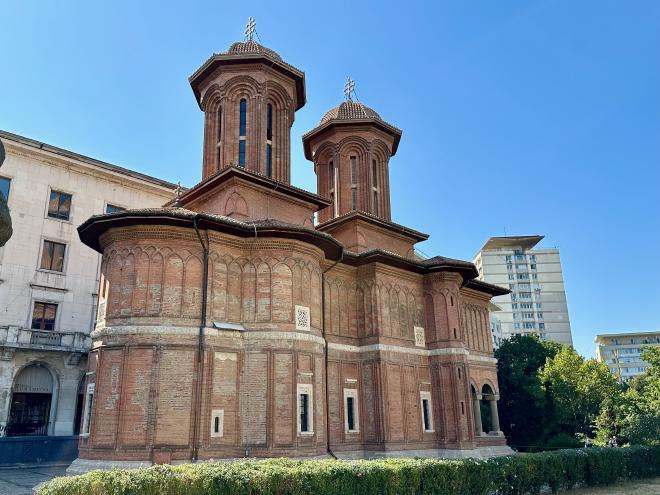
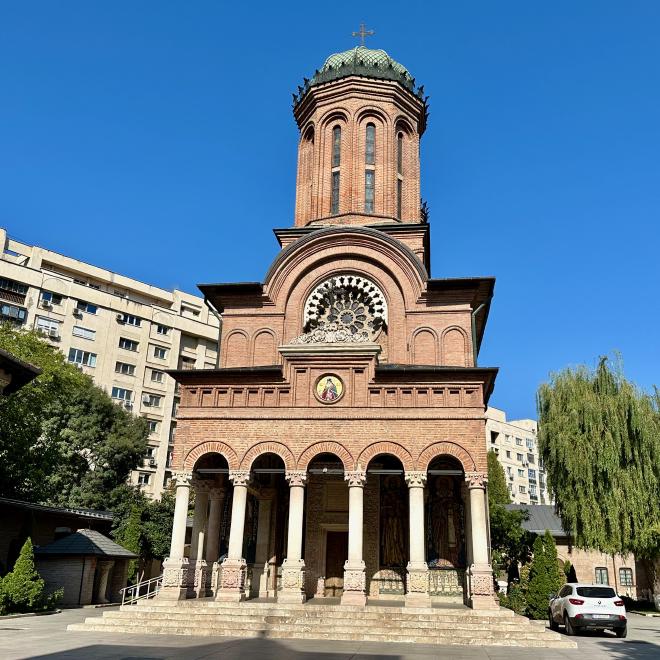
Just beside Revolution Square is Kretzulescu Church, dating from 1722. The church was modified several times in the 1800s, but restored to its original design in the 1920s. It has the tall, narrow shape and rounded domes typical of Eastern Orthodox churches.
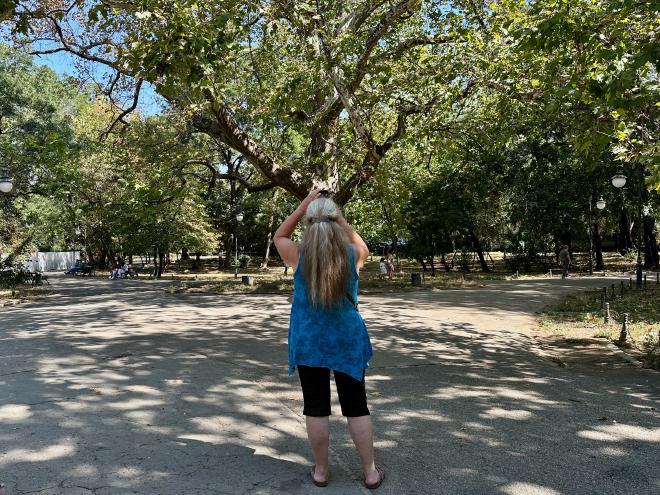
Izvor Park is just north of the Palace of the Parliament and was on our route there. Here is one more in our series of pictures of Karen taking pictures of plants.
The Palace was a vanity project of Romania’s Communist-era dictator, Nicolae Ceaşescu, who apparently got the idea after visiting Kim Il Sung in North Korea and seeing the monumental government buildings he’d constructed. To make room for the Palace and surrounding buildings, Ceaşescu displaced over forty-thousand people and had much of Bucharest’s historic Old Town destroyed. Construction costs exceeded Romania’s total GDP in each of the years it was being built, and contributed significantly to Romania’s national debt and overall poverty.
The Palace was only about 60% complete when the Romanian Communist regime fell in 1989. There was a massive national debate about whether to finish it or tear it down. Ultimately it was completed to the original architectural plans, largely because that was found to be cheaper than demolishing the partially-finished building.
Prepare yourselves for a lot of pictures and explanation of this extraordinary building.
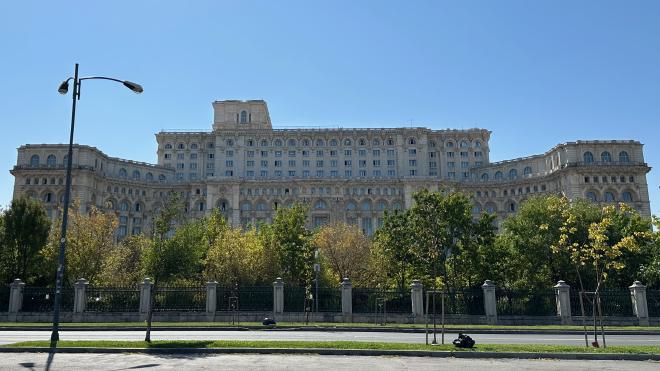
This is rear façade of the Palace of the Parliament, which is where the visitor’s entrance is found. It’s difficult to convey a sense of the Palace’s scale in a photograph, but it’s enormous – the largest Parliament in Europe and the second largest administrative building in the world, after the Pentagon in Washington, DC. The Palace is a square, with diamond-shaped projections at each corner. It was apparently designed without thought to air conditioning – if you look closely, you can see window-mounted air conditioners in about half the upper windows. And it’s ugly, at least on the outside: compare with the beautiful Hungarian Parliament in Budapest.
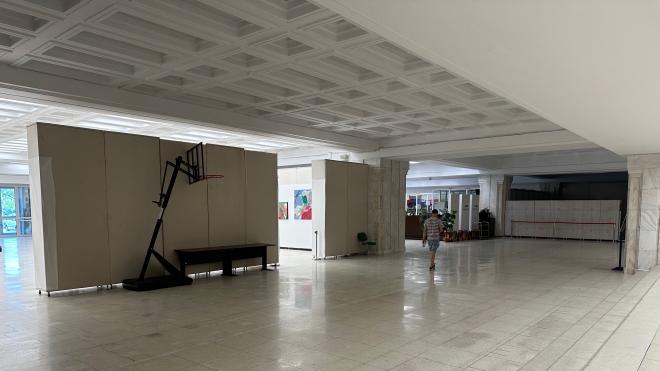
You know how people sometimes tell you a room is big by saying “you could play basketball in there”? The Palace of the Parliament visitor’s lobby literally has a basketball net ready to make the saying true. This is perhaps a tenth of the space; you can just see the edge of an art exhibition behind the divider, also in the lobby, and there’s an enormous waiting area.
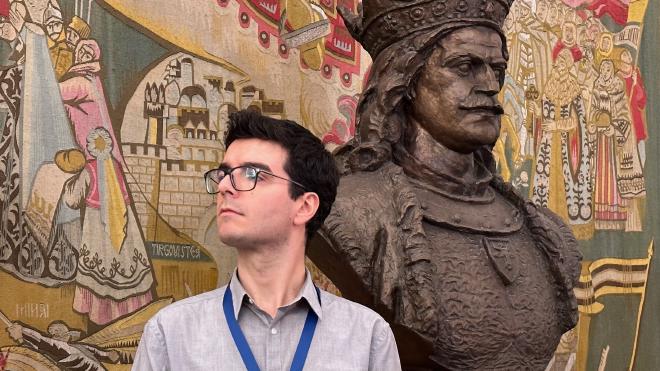
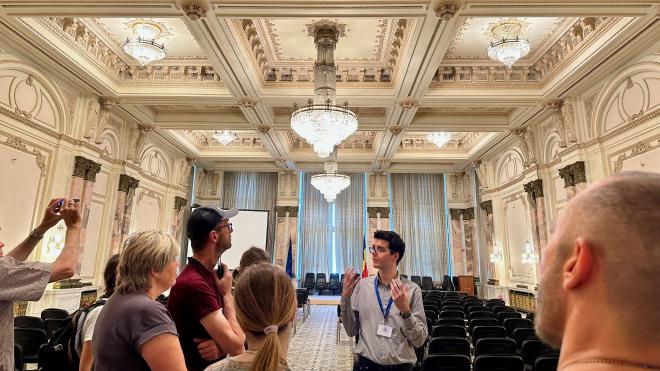
The only way to visit the Palace is by guided tour. If you look online all the tour companies will tell you that you must book ahead, through them, at outrageous prices. Actually, you can purchase your tickets day-of, directly at the Palace, for a quite reasonable fee. Admittedly, we were there in the shoulder season, but we only had to wait half an hour for our tour to start. This is our guide, Francisc, who is a government employee. He was very knowledgeable, and very, very serious. His answer to almost every question was “I’ll get to that later in the tour”. Which, to be fair, he did.
The tour covered just some of the main public spaces on the lower levels of the Palace. At the end of an hour with a lot of hard walking, Francisc advised us that we’d seen about five percent of the building, most of which is government offices. This theatre, seen from the stage, is used to present “culturally significant” performances by Romanian artists. Notice the massive chandelier. There are over a thousand chandeliers in the Palace, all constructed from Romanian crystal.
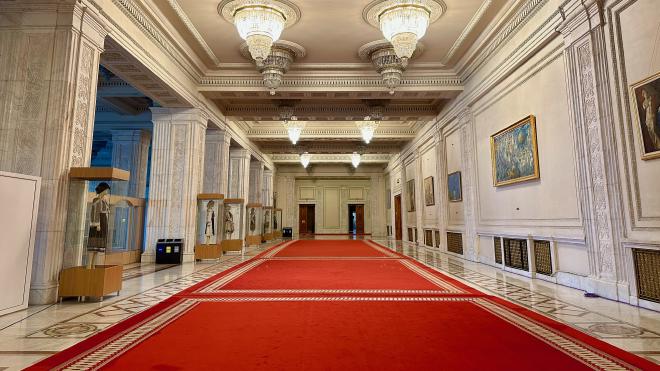
We walked along many corridors, all on grand scales and ornately decorated. Most are used to display Romanian art: here, paintings and examples of traditional Romanian dress.
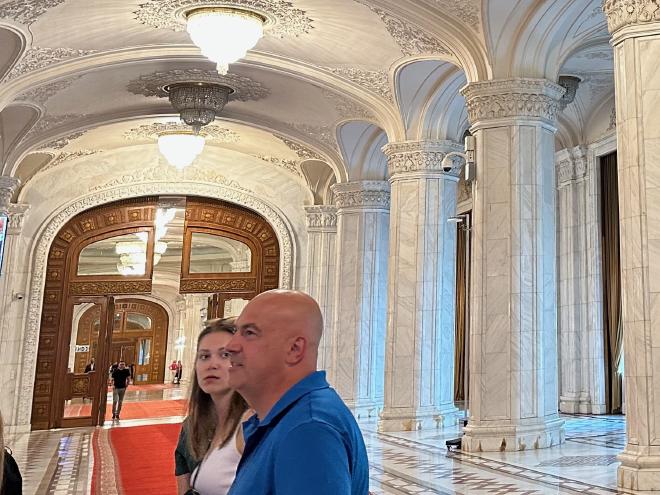
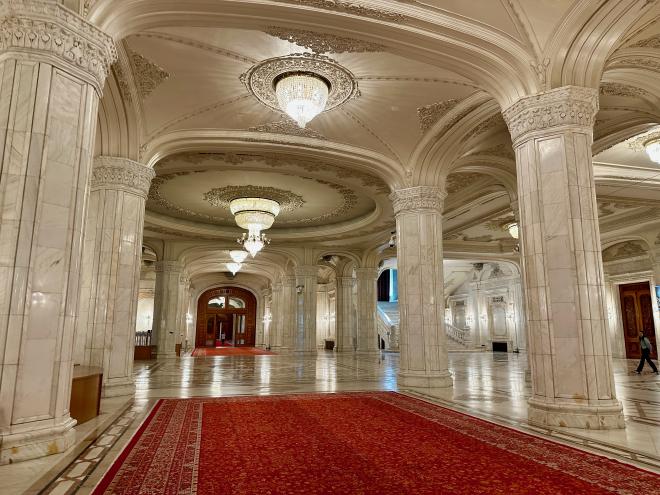
Another ornate corridor. Almost all the materials used to construct the Palace, including the wood panelling and the marble on the floors and pillars, come from Romania.
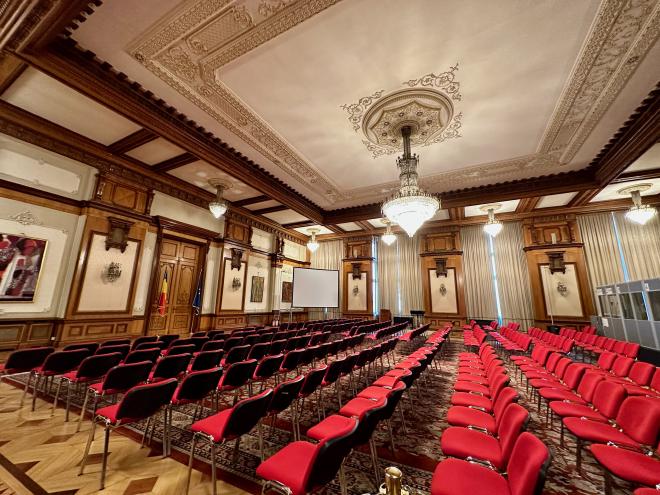
This room is used for large meetings and presentations.
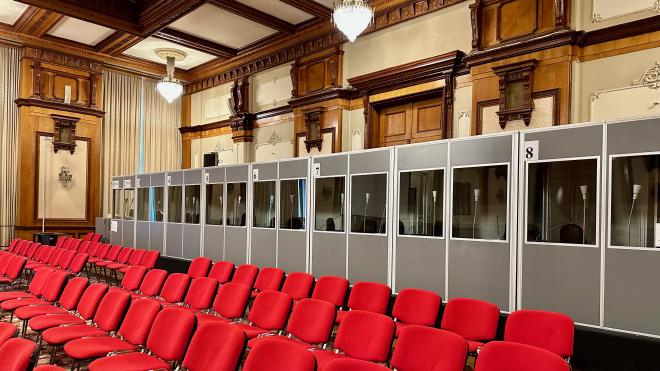
At the back of the room are booths for translators. Number 1 is Romanian, number 2 is English.
Another room used for presentations and meetings, also with translator booths (not shown).
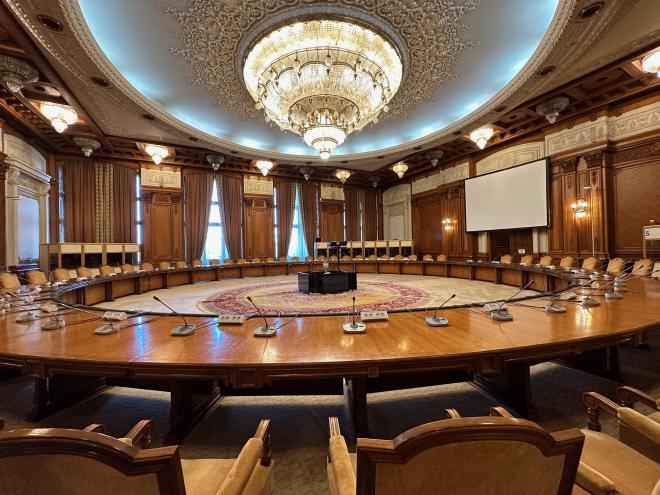
This room is used for meetings of senior members of the Romanian government, as well as for international meetings. Again, you can see the translator booths in the corners of the room.
This reception hall was designed for important presentations and as a mingling space for banquets. It has deliberately-weird acoustics: the intent was that applause would be magnified, making the crowd sound (even?) more enthusiastic than it was.
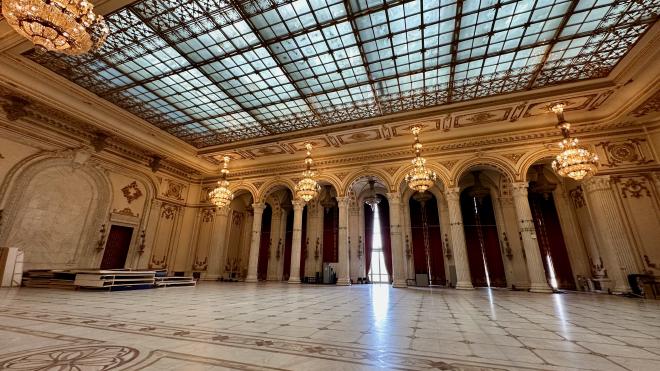
This is the grand ballroom, used for banquets and other large events.
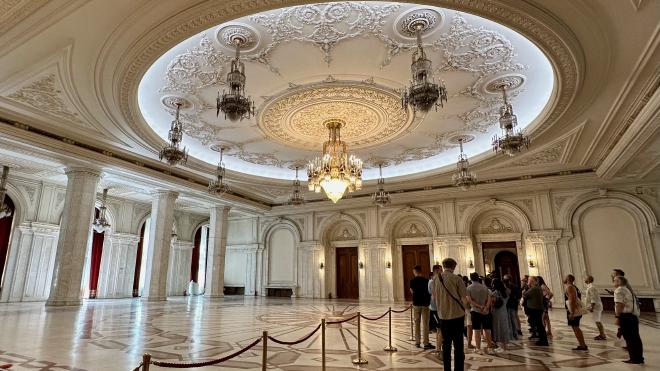
This is the grand entrance to the Palace, seen from the side. It is used primarily to receive visiting Heads of State and other important dignitaries. The main entrance is the brown doorway at the right of the photograph.
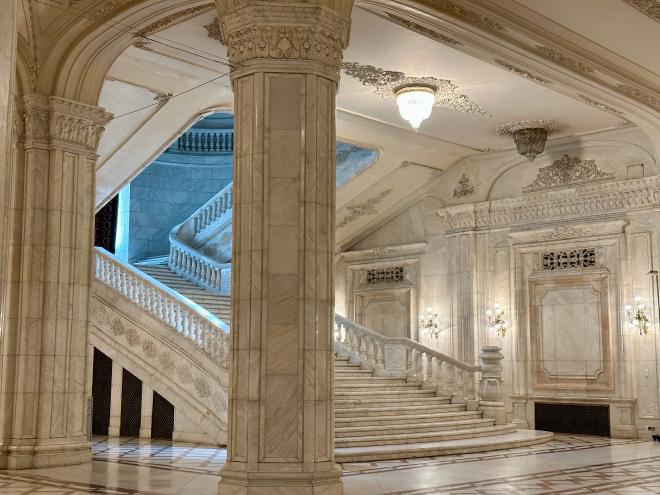
This is Nicolae Ceaşescu’s staircase, also visible in the preceding photograph. There is an identical one, mirroring it, on the far side of the entrance door. The intent was that visitors would come in the door, be overawed by the space, and while they were standing there with their mouths open, Ceaşescu and his wife Elena would descend the two staircases simultaneously to welcome them in grand style. Of course, Ceaşescu never had the chance to put this plan into action as he and Elena were executed by firing squad shortly after the 1989 revolution.
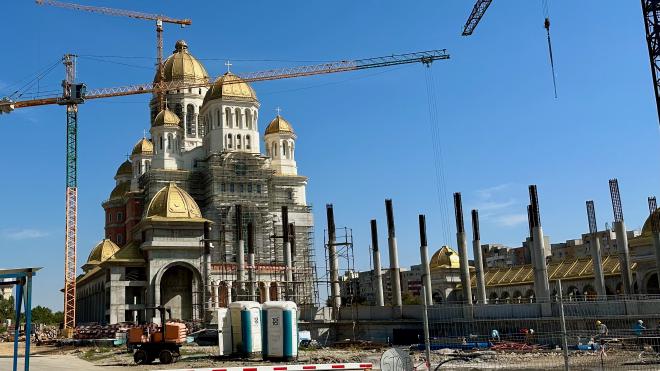
From the Palace of the Parliament we headed back towards the Old Town, first walking a loop around the Palace of the Parliament. At the south-west corner of the loop was People’s Salvation Cathedral, also known as the Romanian National Cathedral. Construction of the Cathedral began in 2010 with completion expected in 2025.
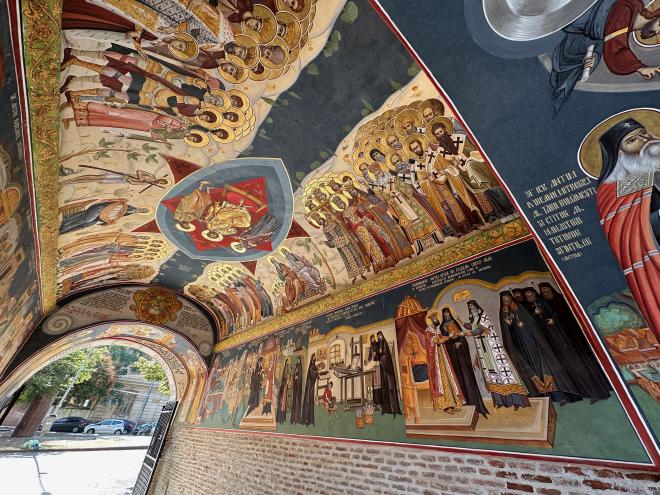
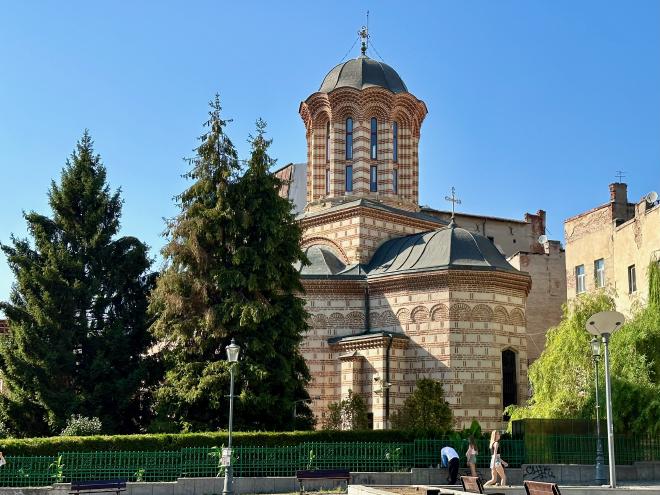
On the way back to the Old Town we passed the Antim Monastery, dating from 1715. This was one of the buildings to have been destroyed to make way for the Palace of the Parliament, but it was instead removed to its current site by civil engineer and professor Eugeniu Iordachescu.
The entry to the Monastery features these impressive (and quite recently-painted) frescoes, in traditional Byzantine style.
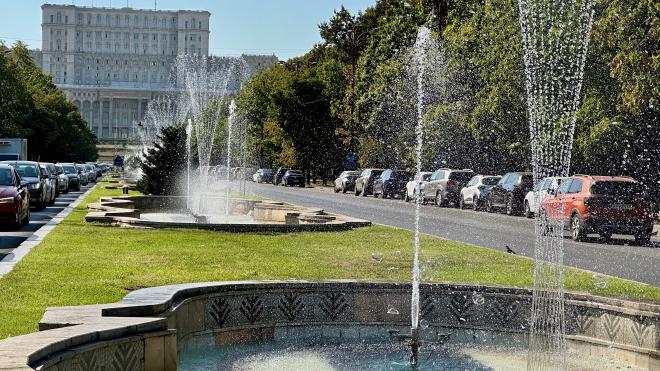
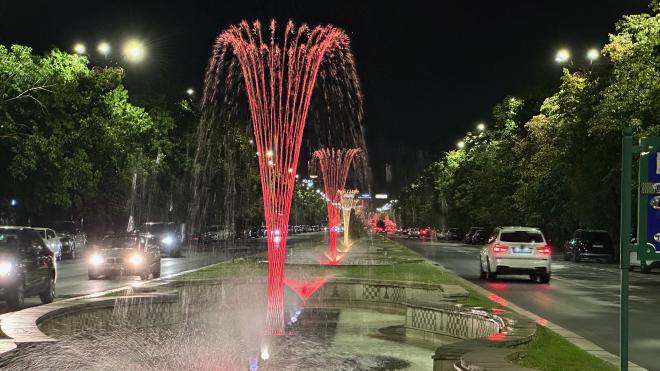
The main boulevard leading away from the Palace of the Parliament, Boulevardi Unirii, is lined with fountains for about 600 metres.
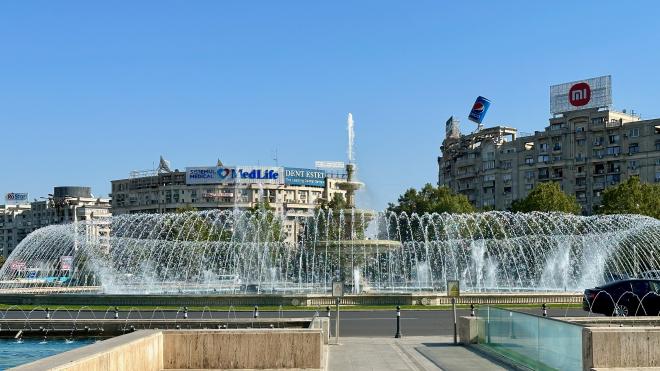
Just south of the Old Town, at the end of the Boulevard, is a large traffic circle with this massive fountain in the centre.
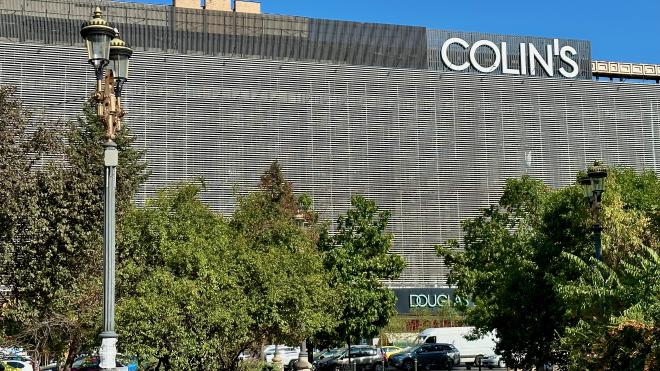
We sent this picture to Greg’s brother Colin, asking if perhaps he’d misplaced a clothing store and a major shopping mall. He replied that he’d be right over to reclaim it.
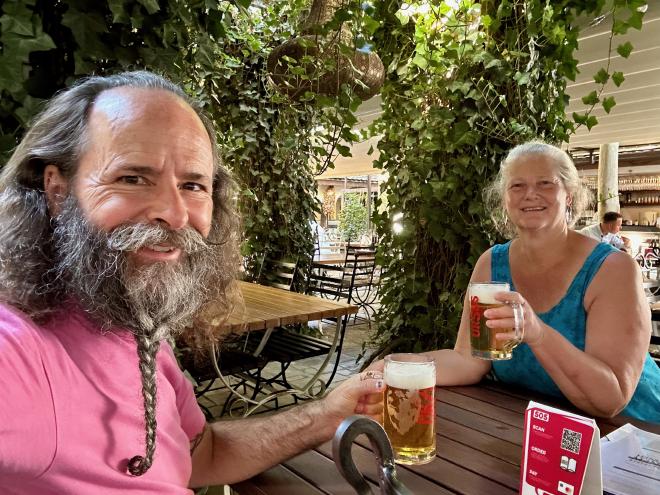
By this point we were well-ready for dinner. Just at the southern edge of the Old Town is Hanu’lui Manuc (Manuc’s Inn), the oldest operating hotel in Bucharest, dating from 1808. It has a massive central courtyard featuring the Hanu’lui Manuc restaurant, which claims to be “The 30th Most Legendary Restaurant in the World” according to Taste Atlas. We can say that the food was good and the service was prompt – if a bit weird. Ordering and payment was via a web application, which you reached by scanning a QR code unique to each table. If you want to cause a bit of mischief, you can go ahead and place an order for table 505.
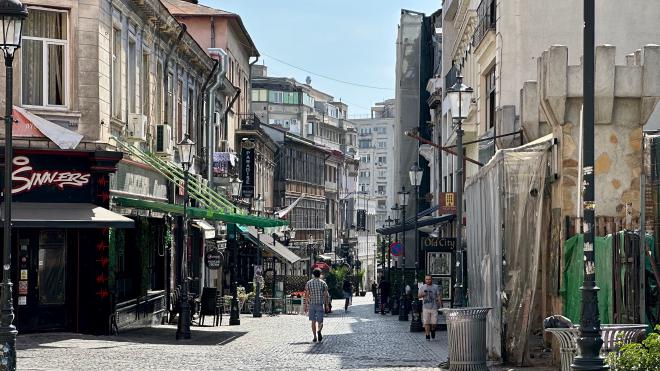
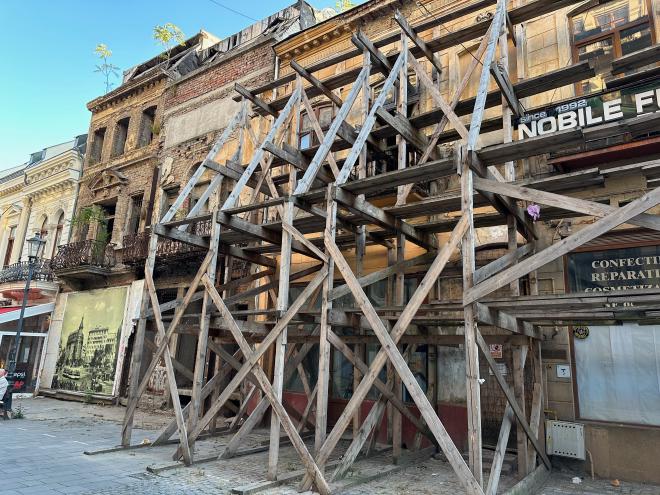
From the restaurant we walked back to our apartment through the Old Town. It’s a study in contrasts, with lovely shopping and entertainment streets like this one…
… a ridiculous number of strip clubs, like Sinners at the far left of this photo and Club Paradise part-way down the street…
The next day we got off to a slow start and had evening plans (about which more below), so we decided to build our day around a walk to Park King Michael I, a few kilometres north of our apartment.
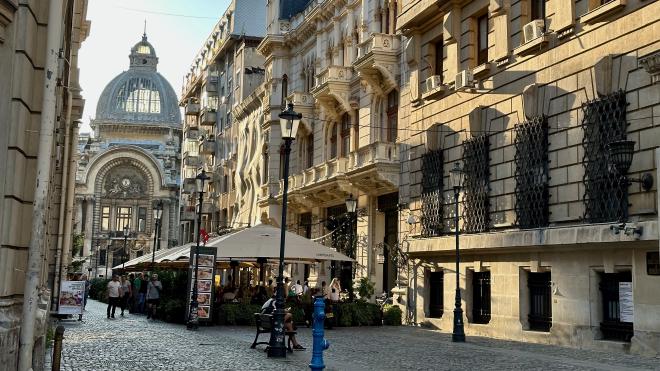
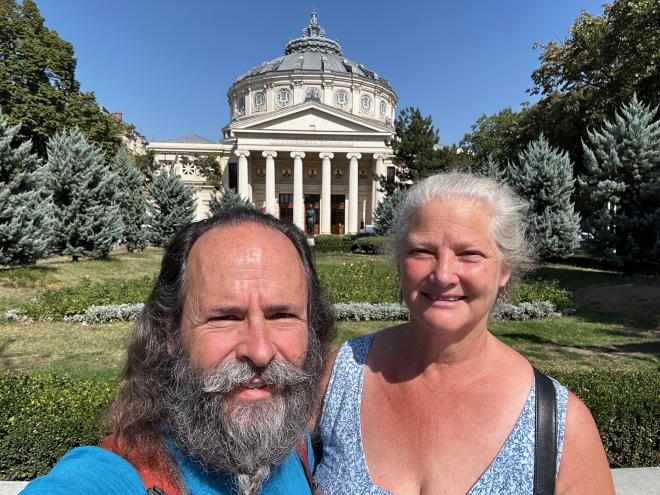
This is the Romanian Athenaeum concert hall. Apparently the interior is fabulous, but the only way to see it is by attending a concert, and they had nothing playing that interested us.
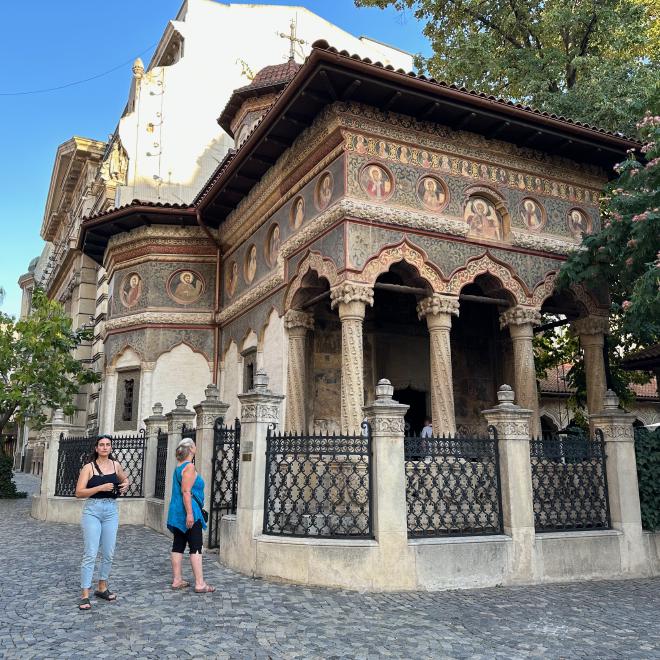
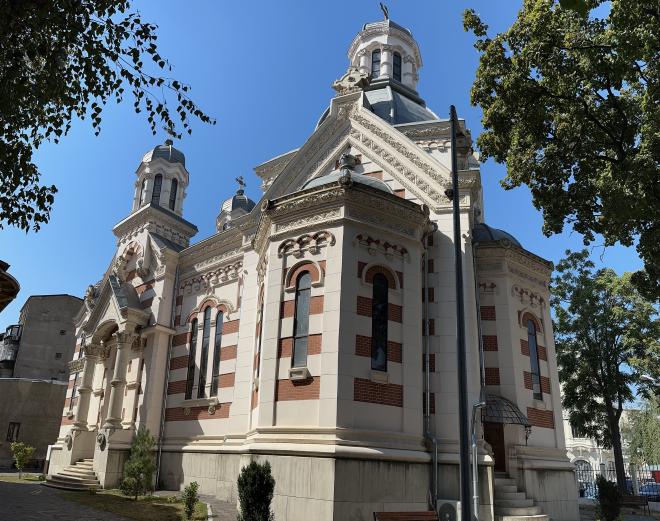
We also passed the Amzei Church along our route. The current structure was completed in 1901, replacing a previous church that had been damaged by fire and ultimately demolished.
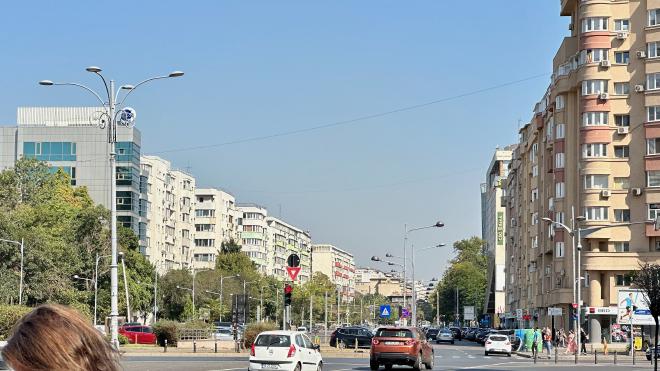
Newer parts of Bucharest are quite modern, with wide, tree-lined streets and attractive apartment buildings.
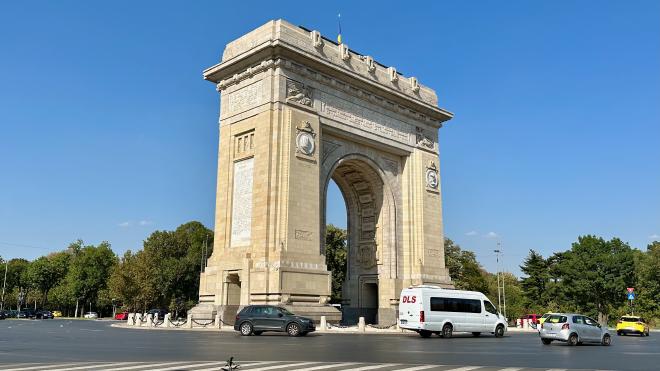
Just south of the Park is Bucharest’s Arcul de Triumf, celebrating Romania’s victory in the First World War and the coronation of King Ferdinand and his wife Marie. It’s deliberately designed after famous Arc in Paris, right down to its placement in the middle of a large traffic circle.
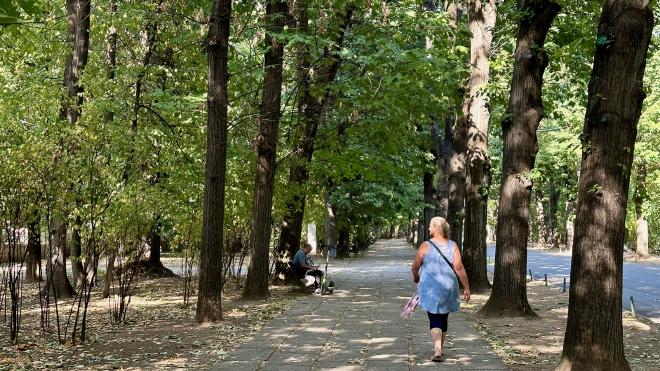
The Park itself is very pleasant with lots of treed pathways.
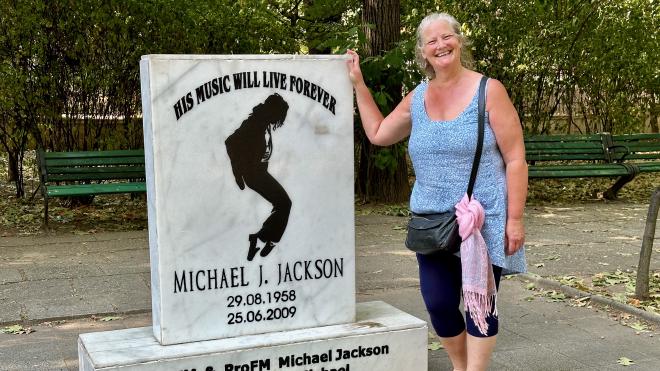
The Park includes a memorial to the other King Michael, of Jackson, who apparently was quite a big deal in Romania.
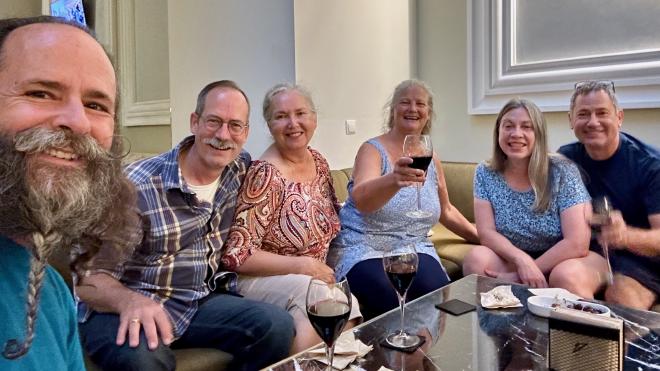
Remember we mentioned our evening plans? Well, it turned out that our friends Steve and Julie Saulnier (second and third from left) were taking a river cruise from Bucharest to Budapest, and their arrival in Bucharest happened to coincide with our visit. Steve and Greg were partners in RMC’s Unarmed Combat Display team in 1982–83, did much of their Signal Officer phase training together, and have been friends for over forty years. At one point Karen shared an apartment with Steve and another friend of ours, and she and Julie have been close almost as long. Also travelling with Steve and Julie were Steve’s brother Norm and Norm’s wife Nancy, at right. Steve and Julie live about nine kilometres from us, back in Kingston, but apparently we had to travel 7500 kilometres to get together for an evening of excellent Romanian red wine and bar snacks.
On our way back from Steve and Julie’s hotel to our apartment we walked down the boulevard of fountains again, this time beautifully illuminated.
For our last day in Bucharest we decided to keep things low-key and took a walk to Bucharest’s other major park, Tineretului Park, which is south of the Old Town.
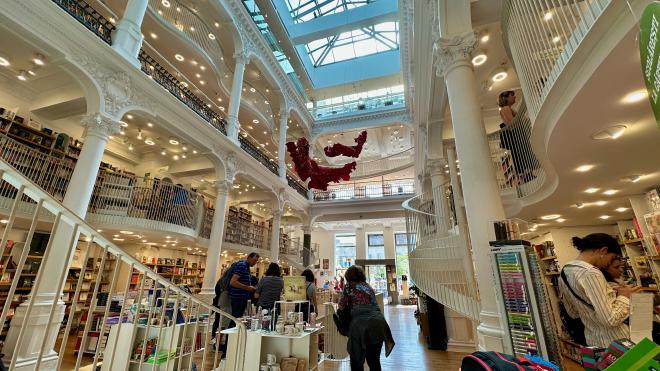
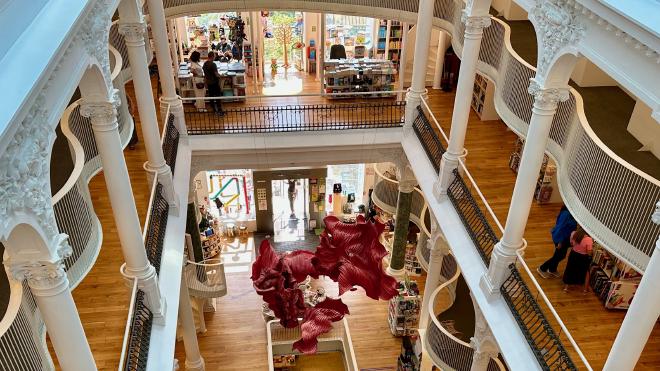
On our way we visited the Cărturești Carusel Bookstore, which has appeared in several tourist guides as one of the most beautiful bookstores in the world. We wouldn’t disagree.
We didn’t purchase any books, because we’re travelling light (and they had a limited selection in English), but we did have refreshing fruit drinks in the cafe on the store’s top level.
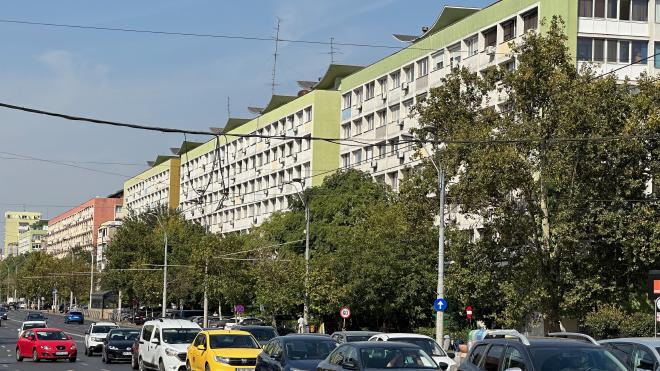
On the way to the Park we passed rows of Communist-era apartment blocks. They were architecturally bland and monotonous, but at least colourful.
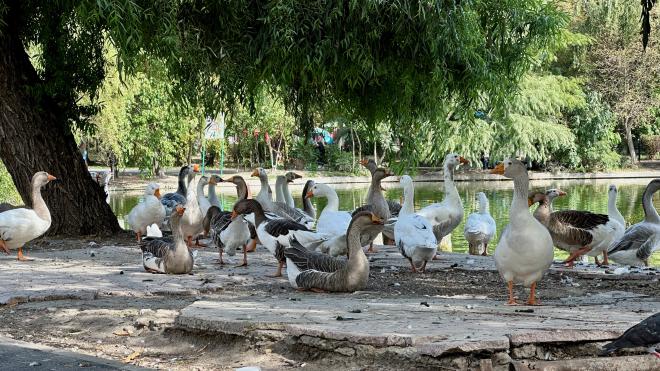
In the Park we made the acquaintance of a number of local residents. Unfortunately their English was a bit limited, so we didn’t have much of a conversation.
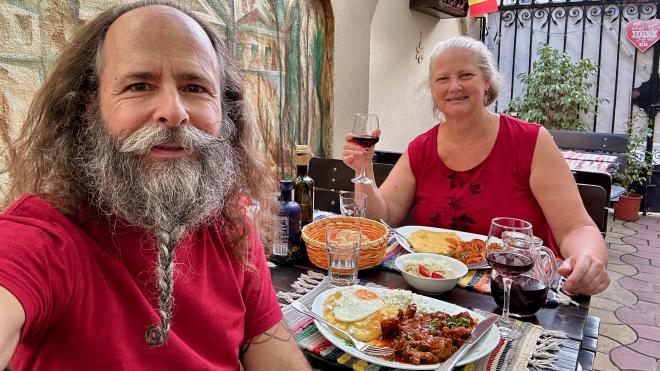
For our last evening meal in Bucharest we stopped at the Restaurant Bucătărasul, where we sampled traditional chicken and pork stews and Romanian-style polenta.
The next morning it was back to the train station and on to the most epic train voyage of our entire trip: the overnight train from Bucharest to Istanbul! (Spoiler: the train is run by the Turkish railway, not the Romanian, and was significantly more pleasant and better maintained than our last two trips. Thank all the gods!)