After Budapest we continued south and crossed into Romania.
Our route was chosen partly out of interest, and partly because of immigration rules. You see, without a special visa, Canadians are only allowed to to stay in the Schengen Area (which includes most countries in Europe) for a maximum of 90 days in any 180-day period. Our total time in Europe is planned for 109 days, so we need to spend at least 19 outside of Schengen. From Stockholm (way back in August) this meant either going west to the United Kingdom, or south and east. Given that we’d lived in the UK for a year back in 2016–17, had never been to south-eastern Europe, and with September weather being what it is, we decided to head south.
(We had also intended to participate in the J-Fest juggling convention in Turkey in late September, but unfortunately that had to be cancelled due to some complicated issues with the venue.)
We had originally planned to go direct from Budapest to Bucharest. This isn’t that far – it takes just a bit over nine hours by car – but unfortunately it takes between sixteen and twenty hours by train. There are no high-speed services on that route, and in fact all the trains are milk runs, stopping at every small town along the way. So, we needed to find an intermediate way station.
Based just on evenly splitting the travel time, the obvious stop was Cluj-Napoca, a city we hadn’t even heard of before planning this trip. However, when we investigated further we discovered it’s the second-largest city in Romania, the capital of Transylvania, and a bustling university hub. So, stopping there became the plan.
Let’s say this up front: we loved our time in Romania but we hated the Romanian trains. They still haven’t dragged themselves entirely out of the Soviet era and passenger comfort just isn’t a priority. No air conditioning, very narrow seats, little space for luggage, and a lack of basic maintenance were features on both of the Romanian trains we took. You can tell from the look on Karen’s face how much she’s enjoying the ride.
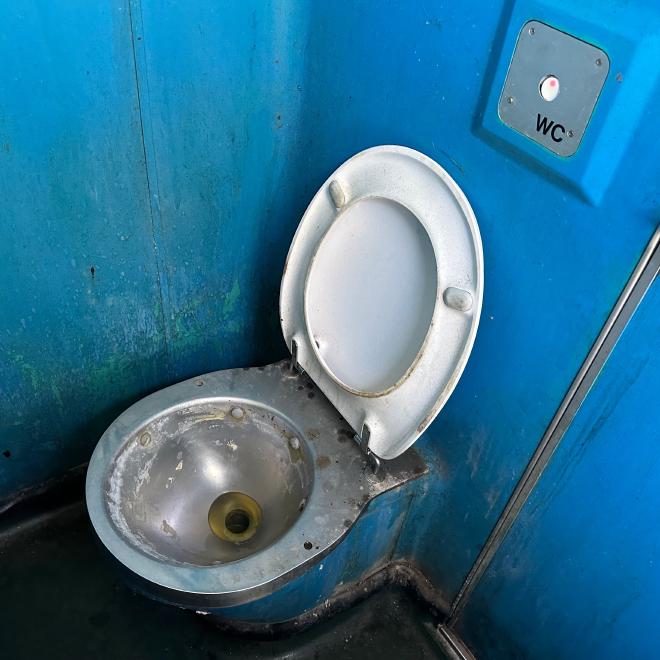
The trains’ toilets were also a delight.
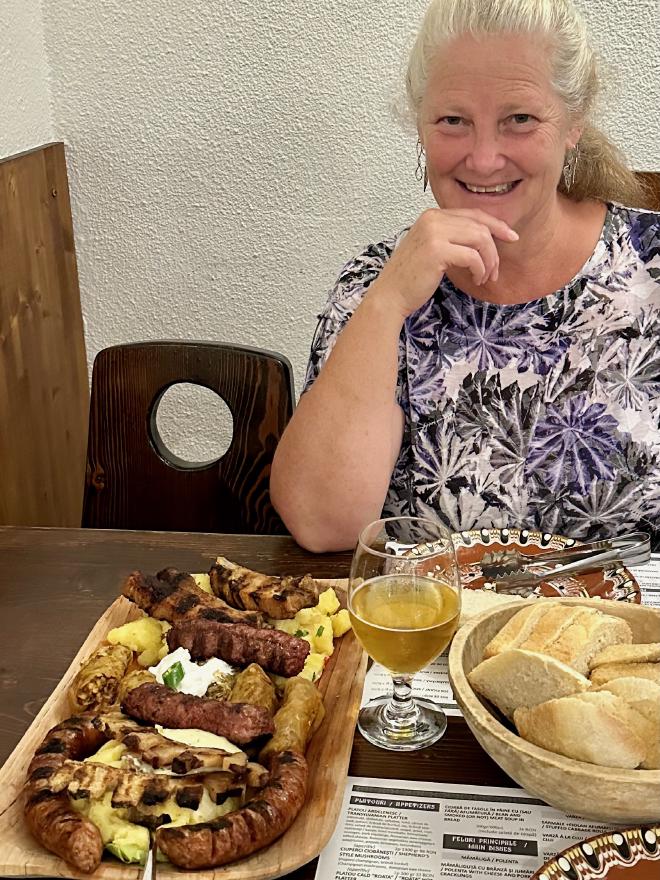
However, the food in Romania was amazing, as long as you don’t mind heavy meat dishes. After checking into our AirBnB, we took our host’s recommendation and headed to Restaurant Roata for a traditional Romanian meal. The menu was extensive and we were having trouble deciding what to order, when we stumbled on this hot platter, billed as a “two person” main meal. Since it included samples of many of the things we were interested in, we decided to give it a go. From the menu: “stuffed cabbage rolls, cabbage à la Cluj, fried homemade sausages, grilled forcemeat, pork ribs, fried bacon, polenta with cheese and pork cracklings, country style potatoes, 1.5 kg.” (Fun fact: Romanian restaurants are required by law to include the weight of each dish they serve.)
We took the next day to recover and catch up on work and a few other things, and mostly stayed in the apartment. However, we did go for a walk up the hill immediately behind us, and Greg took a few pictures when he went out to buy groceries.
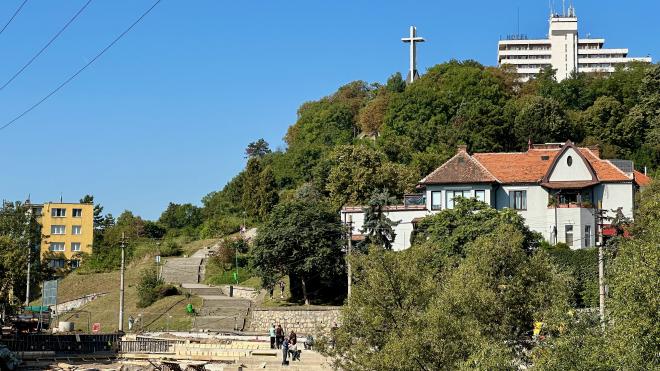
The hill behind our apartment, which was the yellow building at the left of the picture. As you can see, there was some pretty significant road construction going on.
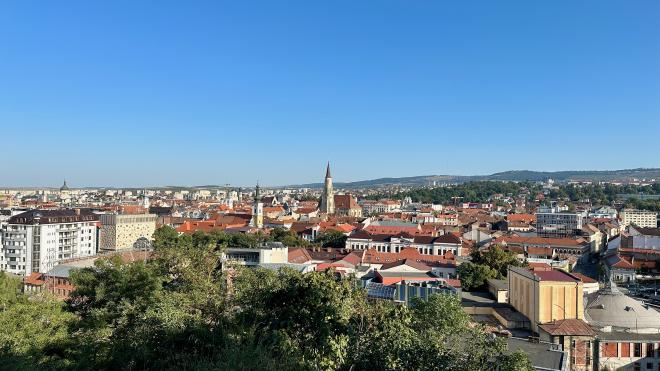
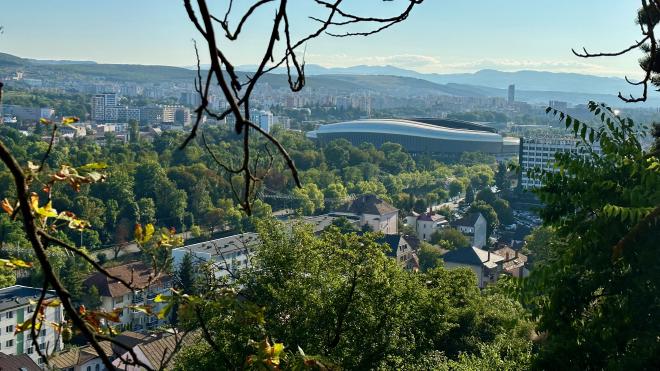
The old city of Cluj-Napoca, viewed from the hilltop.
Of course, Cluj-Napoca also includes a modern area, with a very shiny sports stadium.
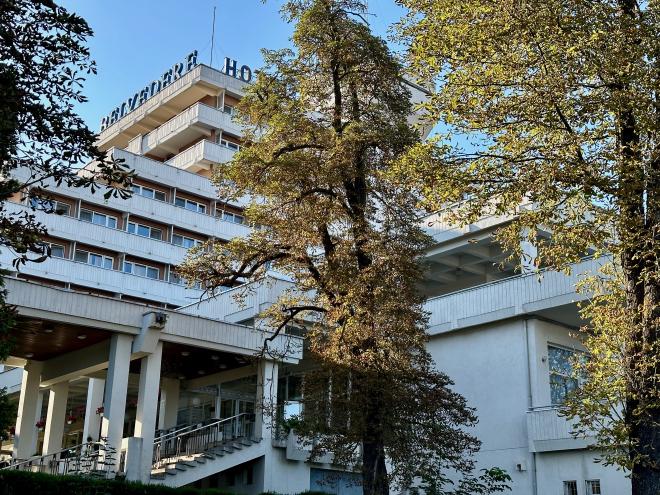
The Belvedere Hotel was on the top of the hill; its terraces were quite striking.
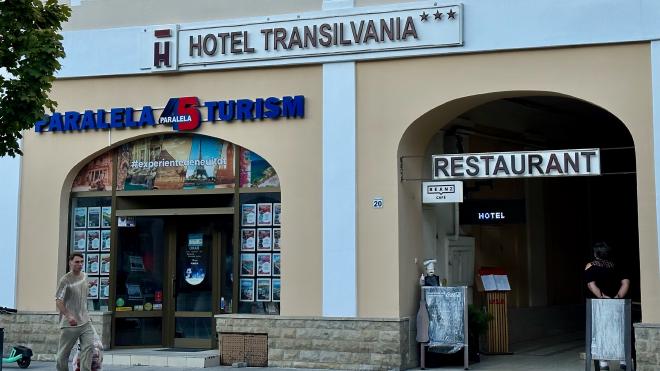
No, this is not the hotel from the animated movie, which spells it with a ‘y’. After growing up immersed in North American media, where the only time you hear the word “Transylvania” is in reference to vampires and other spooky things, it was mildly surreal to see it everywhere and slowly come to grips with the fact that it’s just a geo-political region full of normal folks.
After our rest day, we decided to make a real effort to see some of the city.
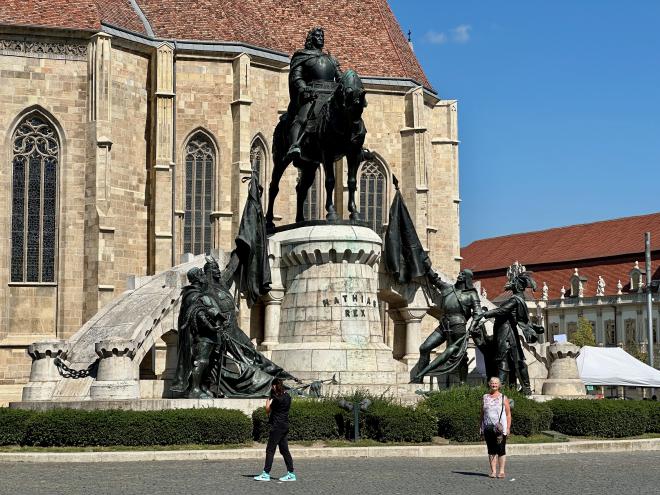
The city’s main square includes this enormous monument to Matthias Corvinus, a Romanian from Cluj-Napoca and who is considered “the greatest Hungarian King” – at least according to the plaque on the home he was born in. As always, the historical truth is more complicated. He became King at the age of 14 and reigned 1458–1490.
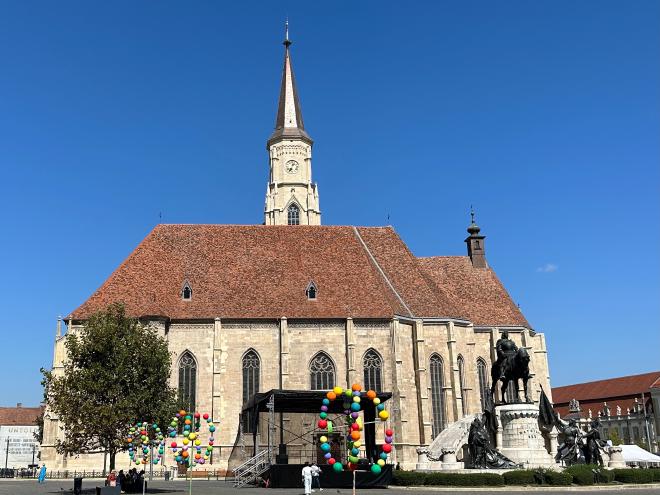
Behind the monument is St. Michael’s Church, built in the mid fifteenth century with its current tower built in the nineteenth. The coloured balls and stage you can see are from a children’s festival that was being set up in the square.
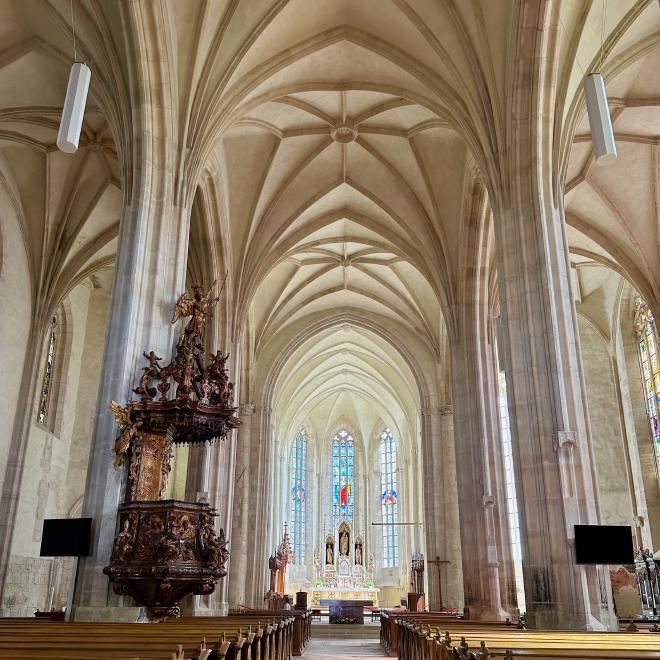
St. Michael’s is extremely plain compared to other Catholic churches of the era. This is a result of its complicated history: originally Catholic, then Lutheran for twenty years, Unitarian for a hundred and fifty, then Catholic again from the counter-reformation in the early 18th century. Its original decorations were removed during the Lutheran and Unitarian eras and never replaced.
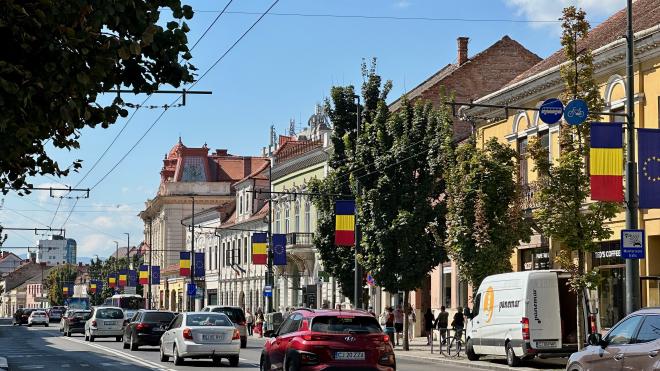
From the square we headed to the Transylvanian Museum of Ethnography, which is dedicated to preserving the rural history of the region. The street out front included this very patriotic display.
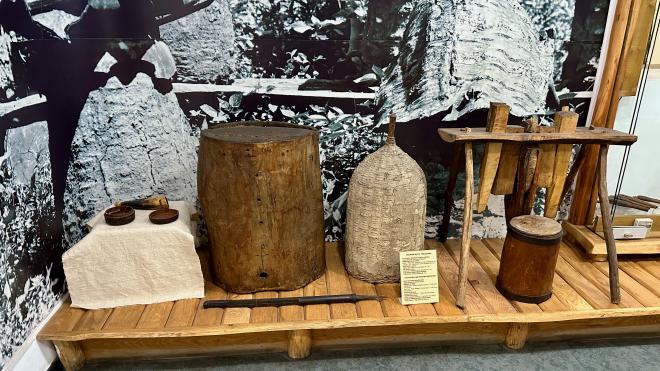
The museum was fascinating, and included a wide range of artifacts from rural occupations of all kinds. This is beekeeping equipment and includes a horn for finding the wild hives, hollow trunk and woven beehives, a wax press, a honey storage container, and a honey comb knife.
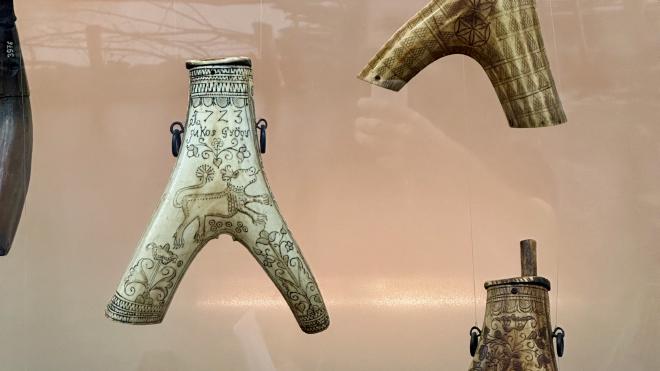
These are decorated powder horns, from hunting.
This is a hand-cranked cereal mill. There is a small millstone in the round section at the top.
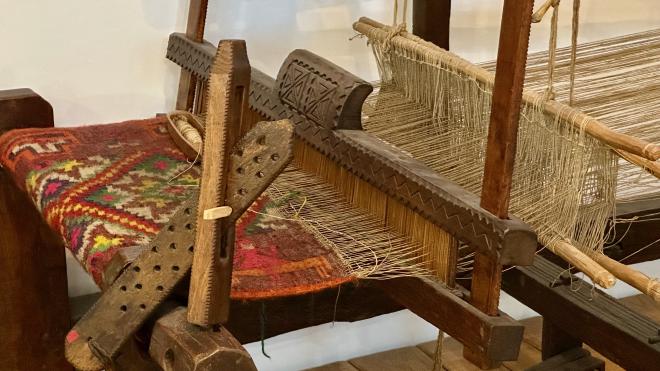
A traditional loom.
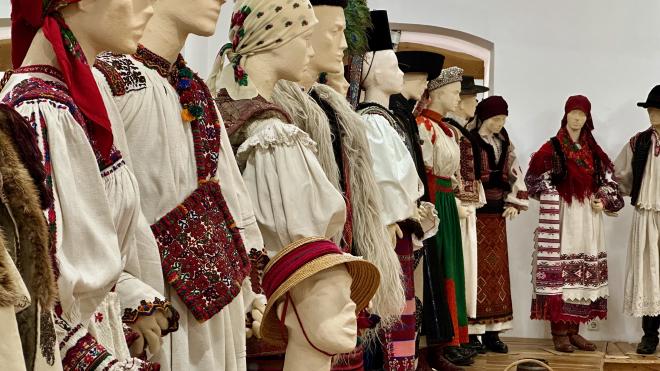
The museum also included an extensive collection of traditional clothing; this is just a very small sample.
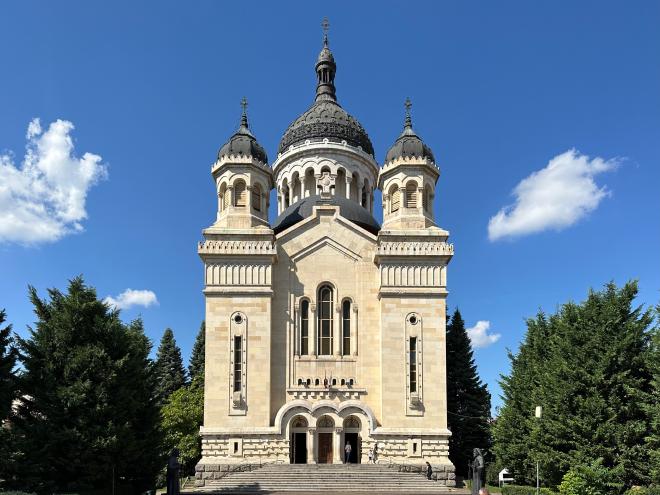
From the Museum we went to the other main town square, which is fronted by the Dormition of the Mother of God Metropolitan Cathedral, one of the first Eastern Orthodox churches we saw on our trip. The Cathedral is very tall and narrow, which is typical of the Orthodox style.
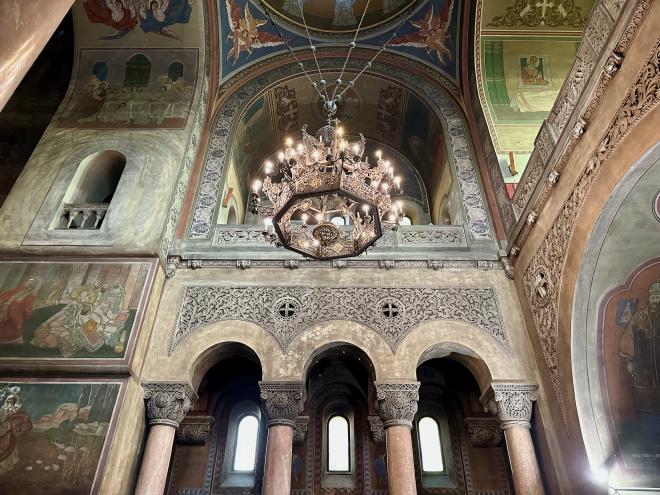
The interior is decorated with frescoes, intricate carvings…
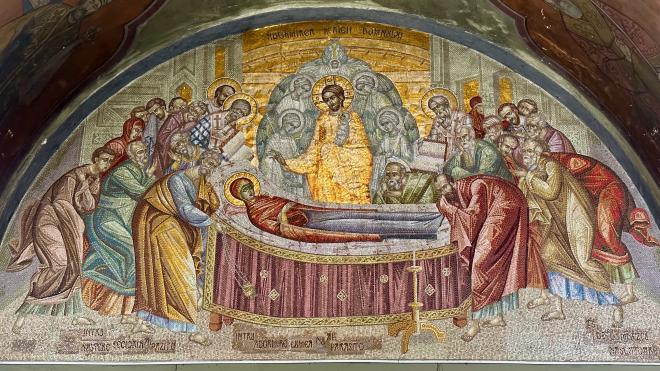
… and mosaics.
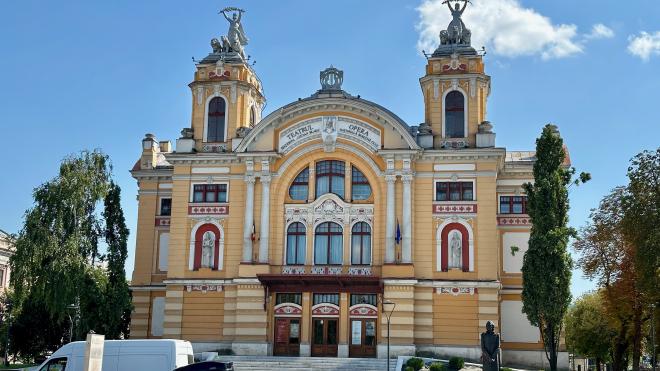
At the other side of the square is the Opera House, a striking neo-classical design.
And nearby is the Court of Appeal; possibly the first pink courthouse we’ve ever seen.
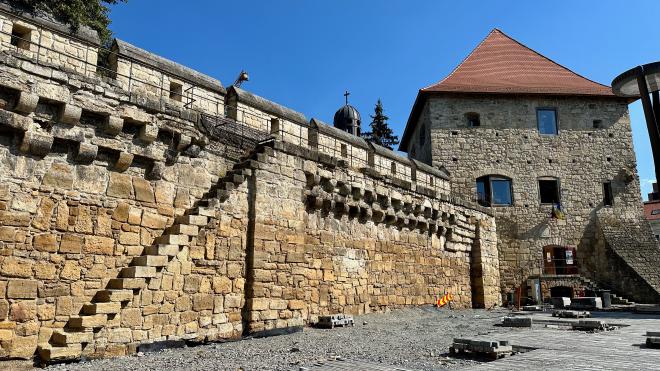
Cluj-Napoca was once a walled city, and small sections of its wall still stand. This is the interior of the wall, along with the best-preserved of its towers, which used to guard the city’s gates.
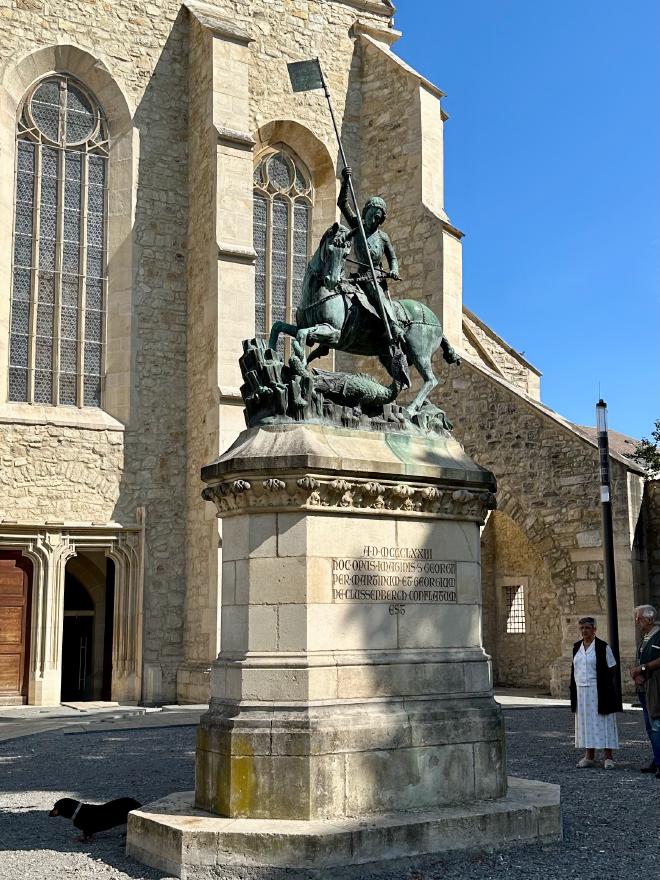
Nearby we found yet another statue of Saint George slaying the dragon. Frankly, at this point we’ve completely lost count.
On our last day in town we decided to visit the Alexandru Borza Botanical Garden. The current garden dates from 1925, but is a continuation of a series of Botanical Gardens in Cluj-Napoca dating back to the early 1800s.
On the way we crossed a small bridge covered in “love locks”. While we’ll admit this makes for a pretty picture, (a) it’s a terrible metaphor: love is a process, not something you can lock, and (b) this is littering, not love. So don’t do it.
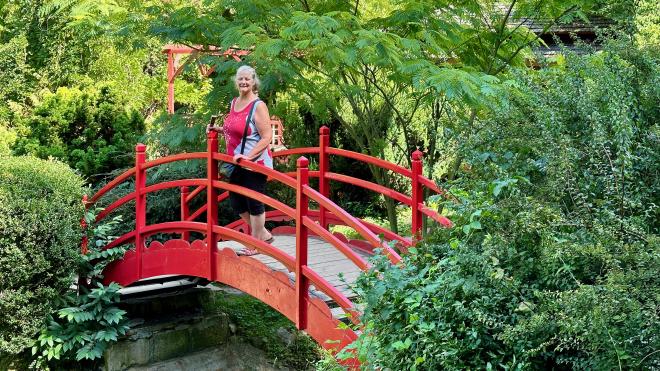
The garden is quite extensive, and includes both “wild” and highly-maintained areas. This is one of the latter, the Japanese Garden.
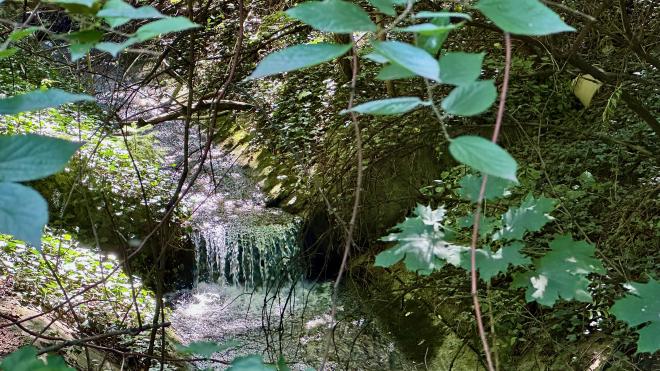
And this is one of the former; a delightful waterfall in a wooded area on one edge of the Garden.
The garden also includes several large greenhouses, such as this one, full of palms and other tropical plants.
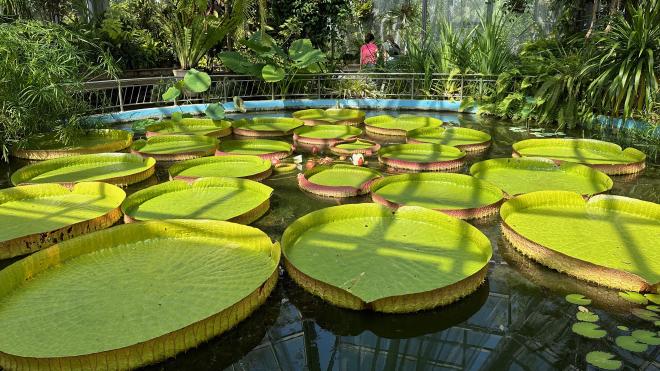
One of the aquatic sections included these enormous Brazilian water lilies, Victoria Amazonica, which are among our favourites.
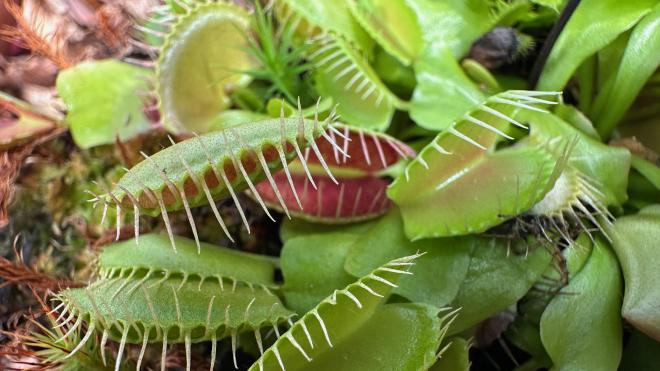
There was a temporary exhibit of carnivorous plants in one of the Garden’s greenhouses. So I guess there are creepy things in Transylvania after all! This is the well-known Venus flytrap. (Side note: we’re continually impressed at the quality of modern iPhone macro photographs!)
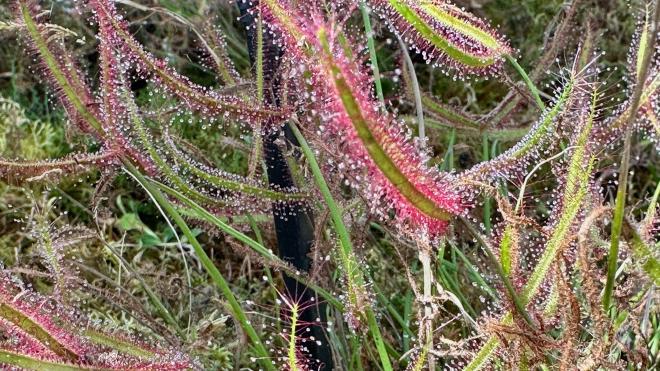
And this is a forked sundew.
Then the next morning it was back on those lovely Romanian trains and on our way to Bucharest.