We had five days between the end of CoastlessCon in Göttingen and the beginning of the European Juggling Convention in Lublin: 24 through 28 July. Our most reasonable train route ran through Berlin, which Karen had never visited, so we decided to stop there for the first three days.
Booking last-minute in the peak summer season gave us very few reasonable options on AirBnB, but we managed to find a small basement studio apartment with a kitchen and a washing machine about 1.5 kilometres north of the centre. It was a bit cramped, but definitely well-stocked with cleaning supplies. There were also fifty-nine spare rolls of toilet paper in the bathroom.
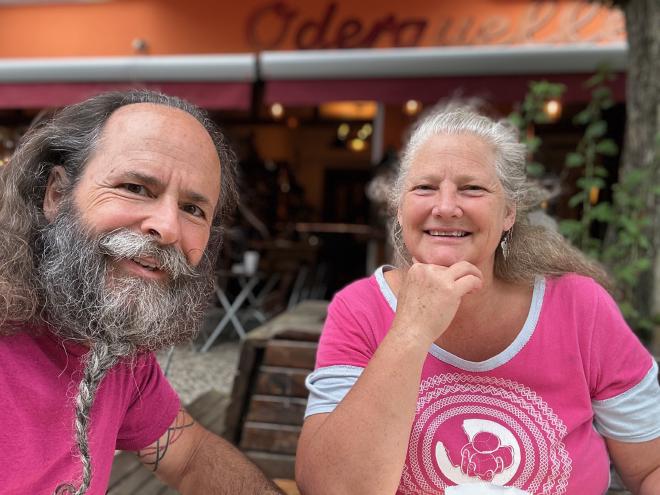
After sorting out our stuff we went to dinner at the Oderquelle, a short walk away. Established in 1990, this is one of the oldest “new” restaurants on the east side of the old Berlin wall and played a significant role in the post-Soviet revitalization of Oderberger Straße, which is now a bustling entertainment district. But we mainly went for the food and beer, which were both excellent.
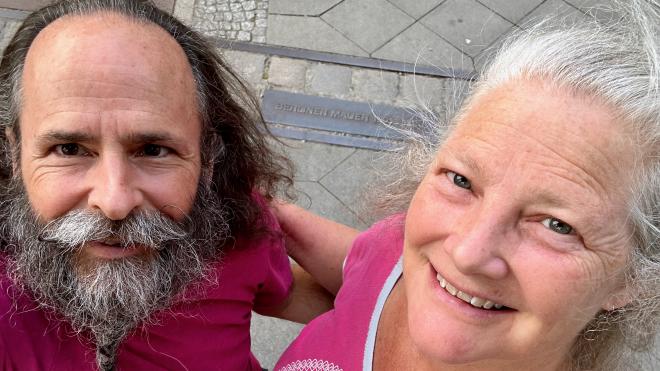
To people of our age, the name Berlin immediately conjures the image of the Berlin Wall, which divided East and West Berlin from 1961 to 1989. That time includes our entire childhoods; the Wall fell after we had both completed university and Greg had started his active military service. On our way back from dinner we crossed the first of many markers showing where the Berlin Wall used to divide the city. It’s important to understand that the Wall divided East and West Berlin, but not East and West Germany. Berlin was entirely within the Soviet-controlled East; however the western part of the city was effectively an “island” of western control.
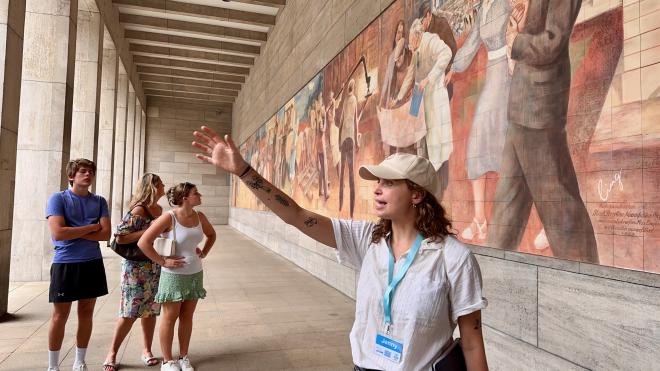
We slept in the next morning. In the afternoon we went on a half-day walking tour of the city centre. This covered a lot of the main sights in town including The Brandenburg Gate, Berlin Wall, Holocaust Memorial, Checkpoint Charlie, Former SS & Gestapo HQ, The Reichstag, The Royal Boulevard (Unter den Linden), The Red Town Hall, Book Burning Memorial, Former Luftwaffe HQ, State Opera House, the story of Ampelmann, Friedrichstrasse shopping mile, Hitler’s Bunker, Museum Island, Tiergarten, Victory Column, TV Tower, The Prussian “City Palace”, and the Berlin Cathedral. Our guide, Jenny, did a wonderful job explaining the history of the Berlin from first settlement through both world wars, the post-war division, the falling of the wall, and reunification.
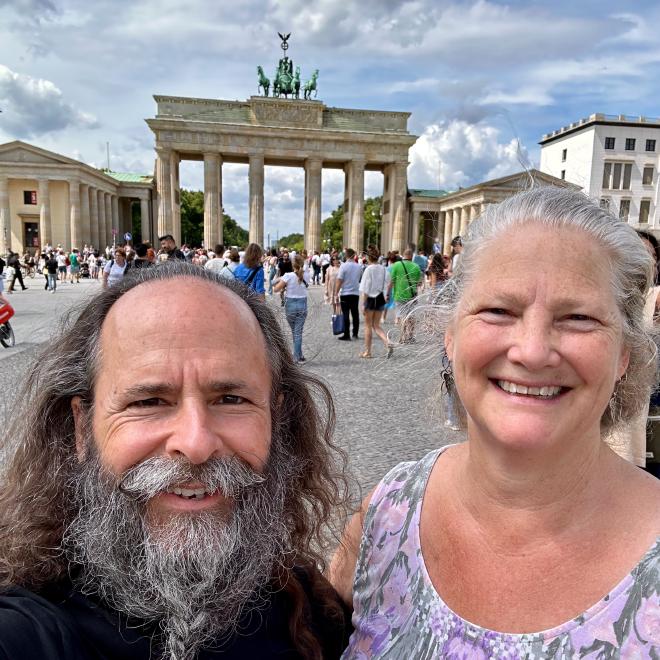
The Brandenburg Gate (Brandenburger Tor) was originally a modest structure marking the start of the road from Berlin to Brandenburg and housing the customs office. The current monumental version was finished in 1791. During the division of Berlin the gate was trapped between the inner and outer walls, so for a 28-year period it was impossible to walk through it.
One of the most affecting sights on the tour was the Memorial to the Murdered Jews of Europe, one of several Berlin memorials to those systematically killed under the Nazi regime. It consists of 2,711 concrete pillars, descending into a deep hollow.
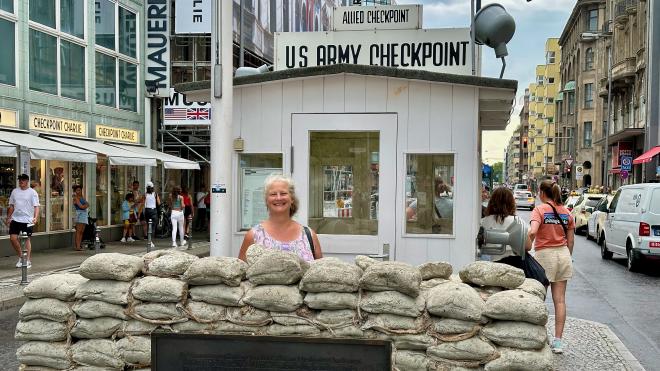
Our tour ended near the site of Checkpoint Charlie, featured in many cold war spy movies. The current version is, of course, a reconstruction.
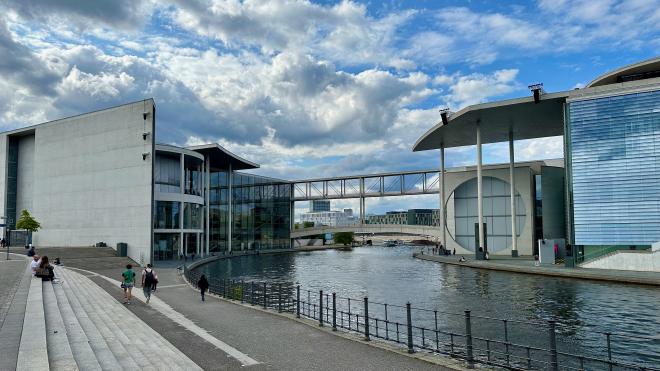
The next day we went out for a long walk along the river and into the Großer Tiergarten. The particularly striking building on the right is the Library of the German Bundestag (parliament).
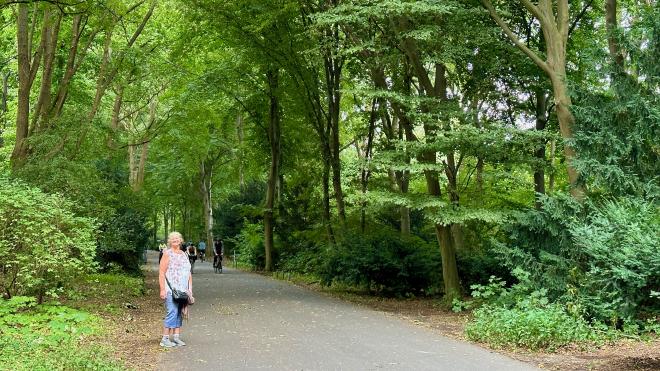
The Tiergarten is a large park just outside the Brandenburg Tor. It is quite densely treed, and crossed by many bicycle and pedestrian paths.
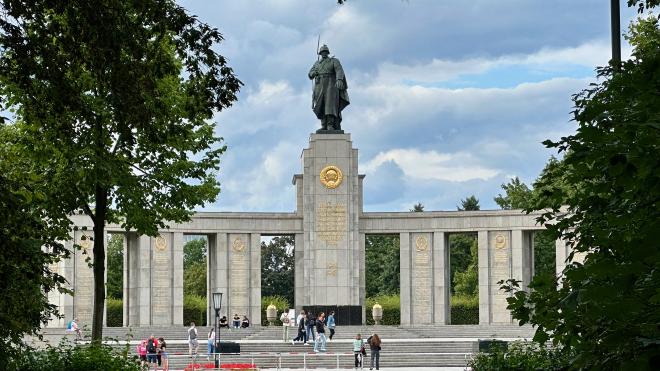
The Tiergarten is home to the Soviet War Memorial, which commemorates the 80,000 Soviet soldiers killed in the Battle of Berlin in April and May 1945.
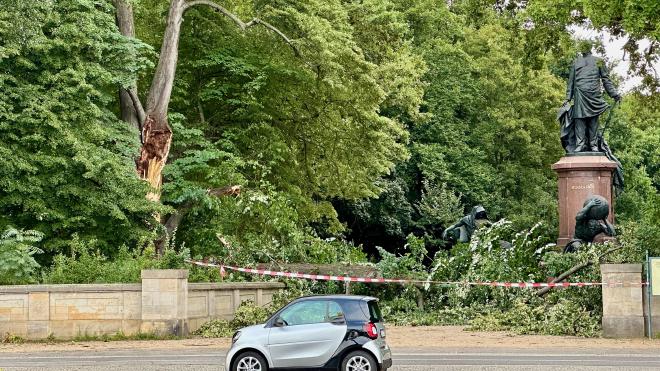
On the evening before our walk in the Tiergarten, a sudden massive thunderstorm, with very high winds, blew through Berlin. Greg was on his way to the grocery store when it struck, and he was forced to retreat into an apartment lobby — which immediately flooded with rain overflowing the apartment’s courtyard. The next day we saw many downed branches and trees, including this one blocking the front of the Bismarck Memorial just to the north of the Victory Column.
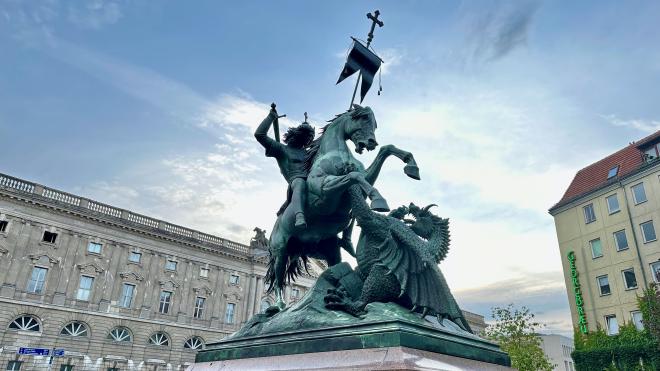
After our walk in the Tiergarten we went to the Zille Stube for a traditional German dinner. On the way we passed this striking sculpture of Saint George slaying the dragon.
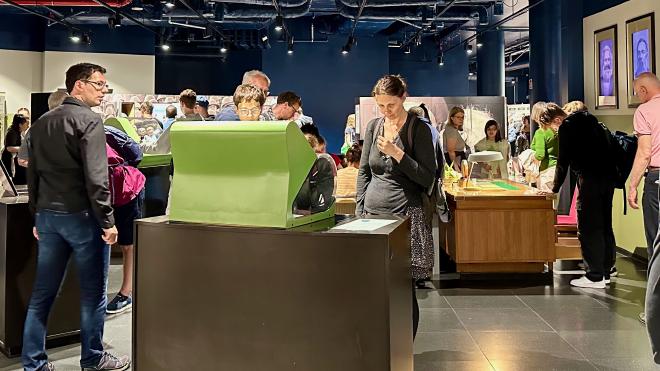
On our last day we started with a visit to the DDR Museum which tells the story of daily life in Soviet-controlled East Germany. While it included a lot of fascinating information it was also overcrowded and difficult to navigate. Many of the exhibits and explanations were in drawers or behind doors, which the museum bills as a plus (“interactive”) but which rapidly became tedious.
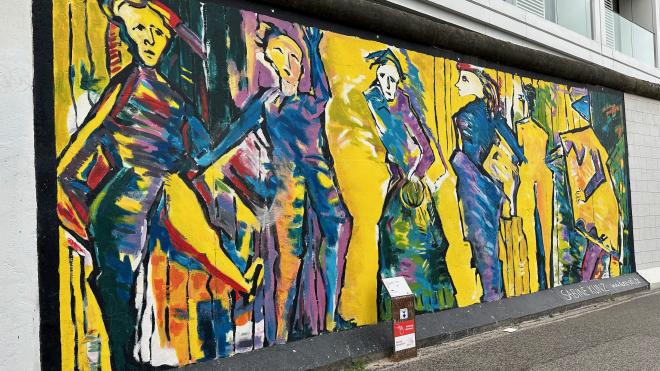
After the museum we walked to the East Side Gallery, which is a 1.3 kilometre-long section of the Berlin Wall that has been preserved and turned into an outdoor public art gallery. There are 105 paintings along the wall, by artists from all over the world. Unfortunately it started raining part-way through our visit, so we didn’t get to spend as much time there as we would have liked.
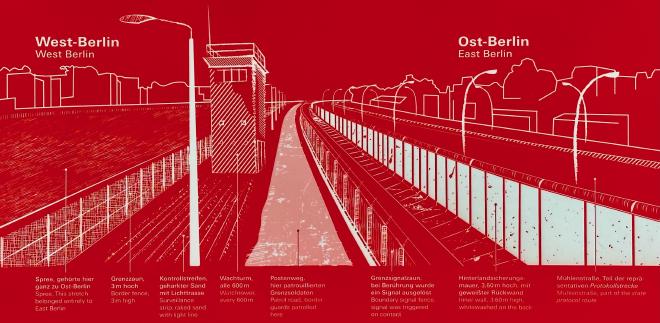
The Berlin Wall, which existed from 1961 until 1989, was actually two walls with guard towers and a “shoot to kill” zone between them.
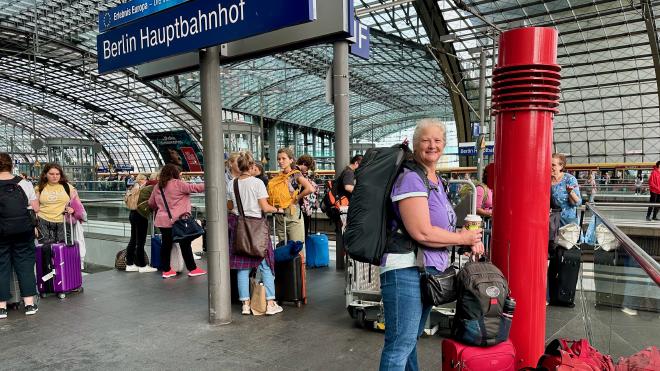
On 27 July we boarded the train to Lublin. Once again, here’s Karen on the platform surrounded by our worldly possessions.